

Authors: Yuliang Ding (UCLA), Marco Velli (UCLA), Chen Shi (UCLA), Zesen Huang (UCLA)
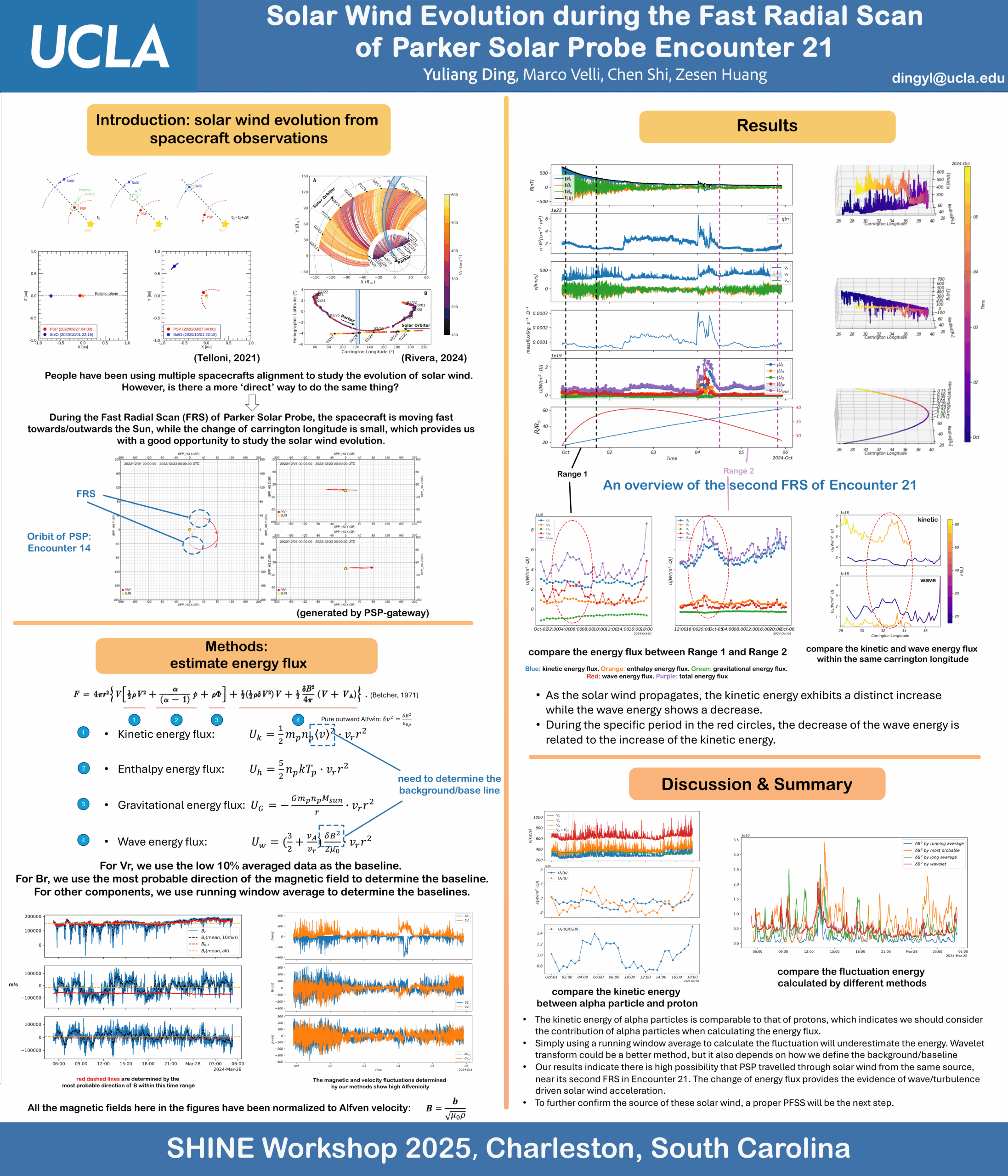
A variety of mechanisms may contribute to the acceleration of solar wind in the near-sun region, such as energy from waves and turbulence. In this study, we attempt to utilize magnetic field and plasma data from Parker Solar Probe (PSP) during its Fast Radial Scans (FRS) to study the evolution of the solar wind. We check the 42 FRS from Encounter 1 to Encounter 21, carry out case studies for Encounter 21, and conduct a comprehensive analysis over the evolution of solar wind near the FRS. We first confirm the solar wind near FRS is from the same source by calculating the mass flux, and after this we analyze the evolution of energy flux including kinetic energy, enthalpy energy, gravitational energy and wave energy, aiming to find clues about the solar wind acceleration. Our results indicate that during this specific case of Encounter 21, as solar wind propagates outward, the kinetic energy exhibits a distinct increase while the wave energy shows a decrease. We believe this could be a direct evidence of wave/turbulence-driven acceleration. A further confirmation will require Potential Field Source Surface (PFSS) modelling.