


Authors: Ronald M. Caplan (Predictive Science Inc.), Tinatin Baratashvili (KU Leuven), Evangelia Samara (NASA Goddard Space Flight Center), Talwinder Singh (Georgia State University), Elena Provornikova (Johns Hopkins University Applied Physics Laboratory), and Jon Linker (Predictive Science Inc.)
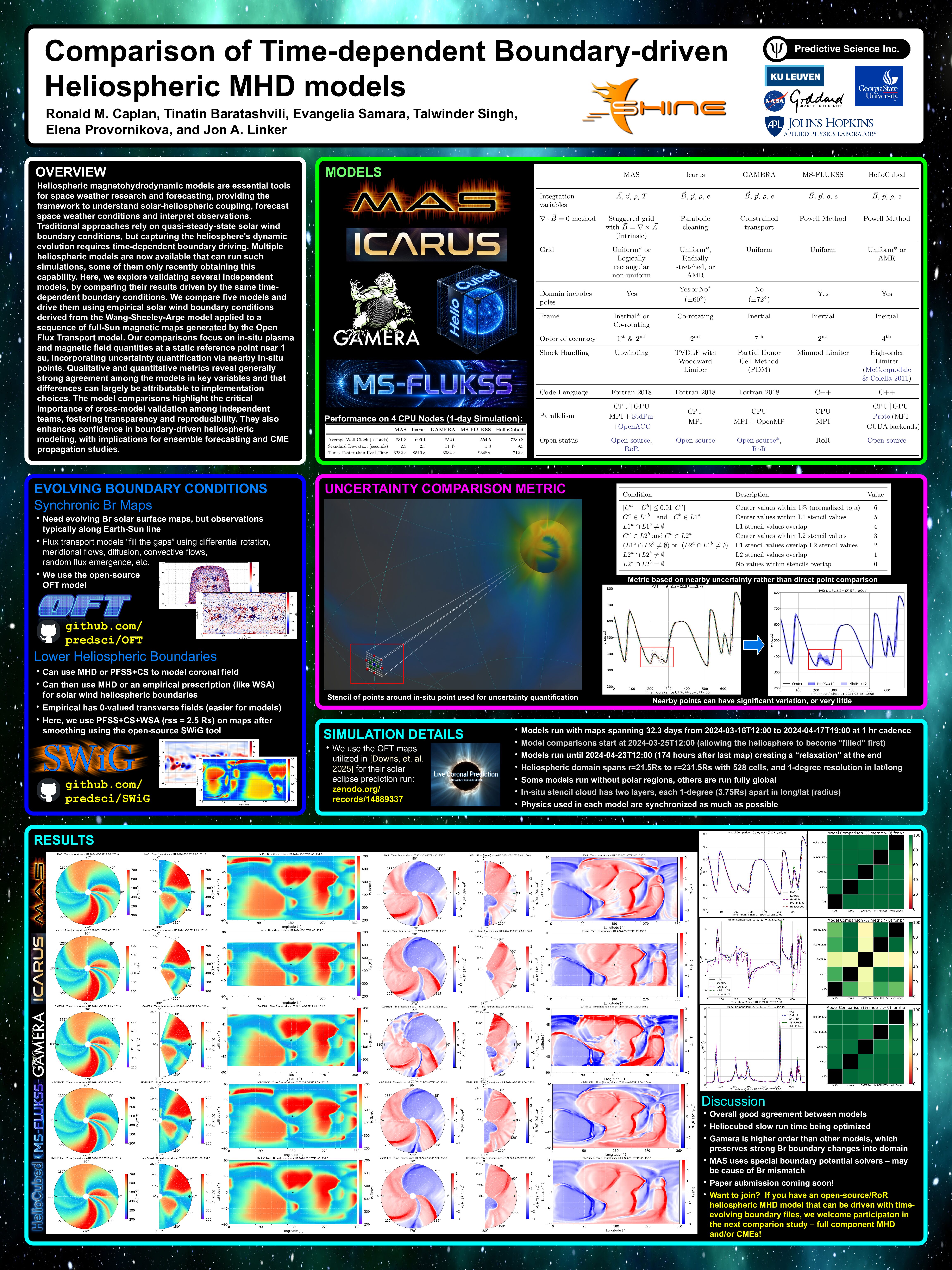
Heliospheric magnetohydrodynamic (MHD) models are an essential tool for space weather research and forecasting, providing the framework to understand solar-heliospheric coupling, forecast space weather conditions and interpret observations. Traditional approaches rely on quasi-steady-state solar wind boundary conditions, but capturing the heliosphere’s dynamic solar wind evolution requires time-dependent boundary driving. Multiple heliospheric MHD models are now available that can run such simulations, with some of them obtaining this capability fairly recently. Here, we explore validating several independent models, by comparing their results driven by the same time-dependent boundary conditions. We compare five models: MAS, Icarus, GAMERA, MS-FLUKSS, and HelioCubed. They are driven using empirical solar wind boundary conditions derived from the Wang-Sheeley-Arge model, applied to a sequence of full-Sun magnetic maps generated by the Open Flux Transport model. Our comparisons focus on in-situ plasma and magnetic field quantities at a static reference point near 1 au, incorporating uncertainty quantification via clouds of nearby in-situ points. Qualitative and quantitative metrics reveal generally strong agreement among the five models in key variables and that differences are attributable to implementation choices of the models. The model comparisons highlight the critical importance of cross-model validation among independent teams, fostering transparency and reproducibility. They also enhances confidence in boundary-driven heliospheric modeling, with implications for ensemble forecasting and CME propagation studies.