


Authors: Kathryn Whitman (KBR, NASA JSC SRAG), A. Steve Johnson (Leidos, NASA JSC SRAG), Ian Richardson (University of Maryland, NASA GSFC), Weihao Liu (University of Michigan), Alessandro Bruno (Catholic Universities of America, NASA GSFC), Christina Cohen (CalTech), Lulu Zhao (University of Michigan)
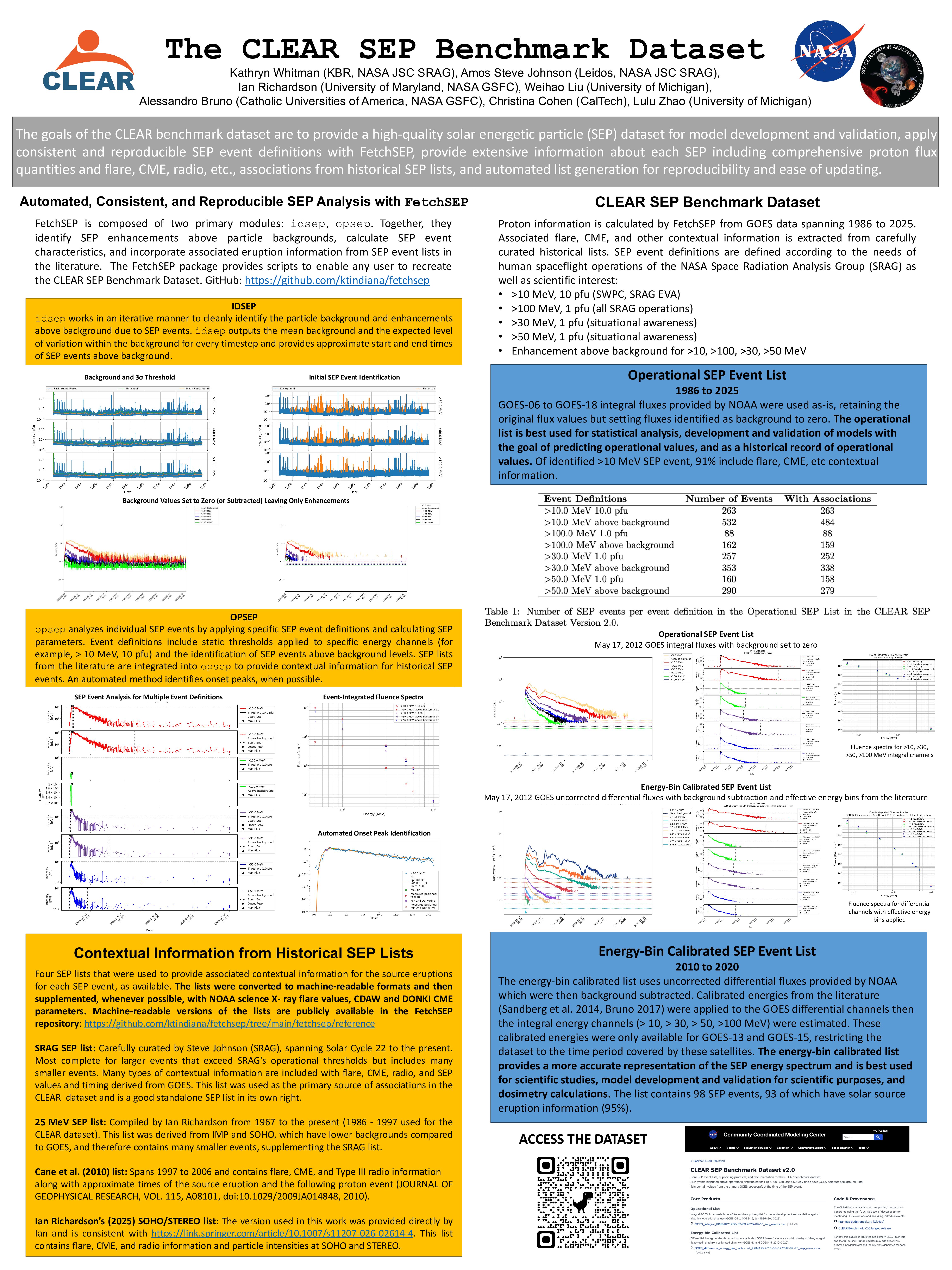
The CLEAR solar energetic particle (SEP) Benchmark Dataset is a product of the CLEAR Space Weather Center of Excellence at the University of Michigan and the Space Radiation Analysis Group (SRAG) at NASA Johnson Space Center. The dataset was created with the FetchSEP python package, developed by Kathryn Whitman (kathryn.whitman@nasa.gov) and available in a public repository: https://github.com/ktindiana/fetchsep.
The repository is tagged with the version that created the CLEAR Benchmark Dataset Version 2.0 with the release: https://github.com/ktindiana/fetchsep/releases/tag/CLEAR_Benchmark_v2.0.
The CLEAR SEP Benchmark Dataset is hosted by NASA CCMC and available online at:
https://ccmc.gsfc.nasa.gov/swxcoe/clear/
https://ccmc.gsfc.nasa.gov/swxcoe/clear/benchmark.php
Operational SEP event list
GOES integral PRIMARY.1986-02-03.2025-09-10 sep events.csv: The integral fluxes provided by NOAA were used as-is, retaining the original flux values but setting fluxes identified as background to zero. The operational list is best used for statistical analysis, development and validation of models with the goal of predicting operational values, and as a historical record of operational values. The list contains 532 SEP events, 484 of which have solar source eruption information (91%).
Energy-bin calibrated SEP event list
GOES differential energy bin calibrated PRIMARY.2010-08-02.2017-09-20 sep events.csv: The energy-bin calibrated list uses uncorrected differential fluxes provided by NOAA which were then background subtracted. Calibrated energies from the literature (Sandberg et al. 2014, Bruno 2017) were applied to the GOES differential channels and the integral energy channels (> 10, > 30, > 50, >100 MeV) were estimated. The Energy-bin calibrated list provides a more accurate representation of the SEP energy spectrum and is best used for scientific studies, model development and validation for scientific purposes, and dosimetry calculations. The list contains 98 SEP events, 93 of which have solar source eruption information (95%).


