

Authors: Elizabeth Wraback (HAO/NSF NCAR), Samaiyah Faird (Alabama A&M University), Thomas Schad (NSO), Urszula Bak-Steslicka (University of Wroclaw), Giuliana de Toma (HAO/NSF NCAR), Yuhong Fan (HAO/NSF NCAR), Sarah Gibson (HAO/NSF NCAR), Mari Paz Miralles (Center for Astrophsics | Harvard & Smithsonian), Jie Zhang (GMU), Suman Dhakal (GMU)
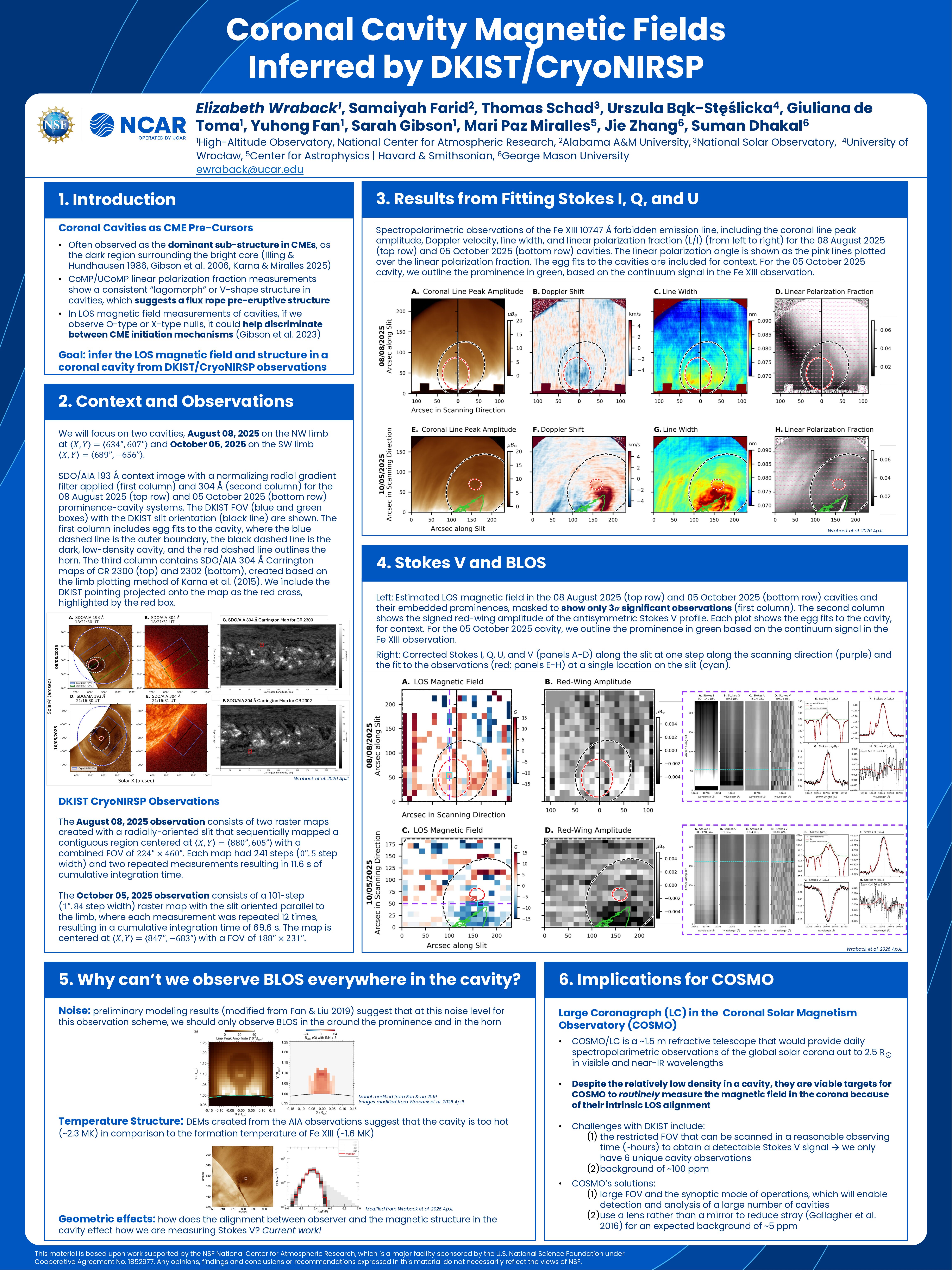
Coronal cavities are low-density regions in the solar corona surrounding prominences that often erupt into coronal mass ejections. Therefore, understanding the magnetic field in these pre-eruptive structures is important for understanding the process of magnetic energy storage and release in the solar corona, with implications for space weather modeling and predictions. The Daniel K. Inouye Solar Telescope (DKIST)/CryoNIRSP instrument acquired spectropolarimetric observations of the Fe XIII 10747 Å forbidden emission line in two coronal cavities, one on the northwest limb on 08 August 2025 and the other on the southwest limb on 05 October 2025. For the first time, we detect the circularly polarized emission in the Stokes V parameter in the coronal cavities and their embedded structures, which could be resolved such that the line-of-sight (LOS) magnetic field intensity could be estimated using the weak-field approximation. It is found that the inferred LOS magnetic field strength varies from about 5 to 20 G in the cavity, with the strongest field strength above the prominence in the horn-like substructure of the cavity. We will also discuss the implications of the results for future observations with the proposed Coronal Solar Magnetism Observatory (COSMO).