

Authors: Andres Munoz-Jaramillo (Southwest Research Institute), Isabel Tejada-Sanchez (Universidad de los Andes), Phoebe Mahlin (Universidad de California - Berkeley), Claudia Holland (Universidad de California - Berkeley), Daniel Zevin (Universidad de California - Berkeley)
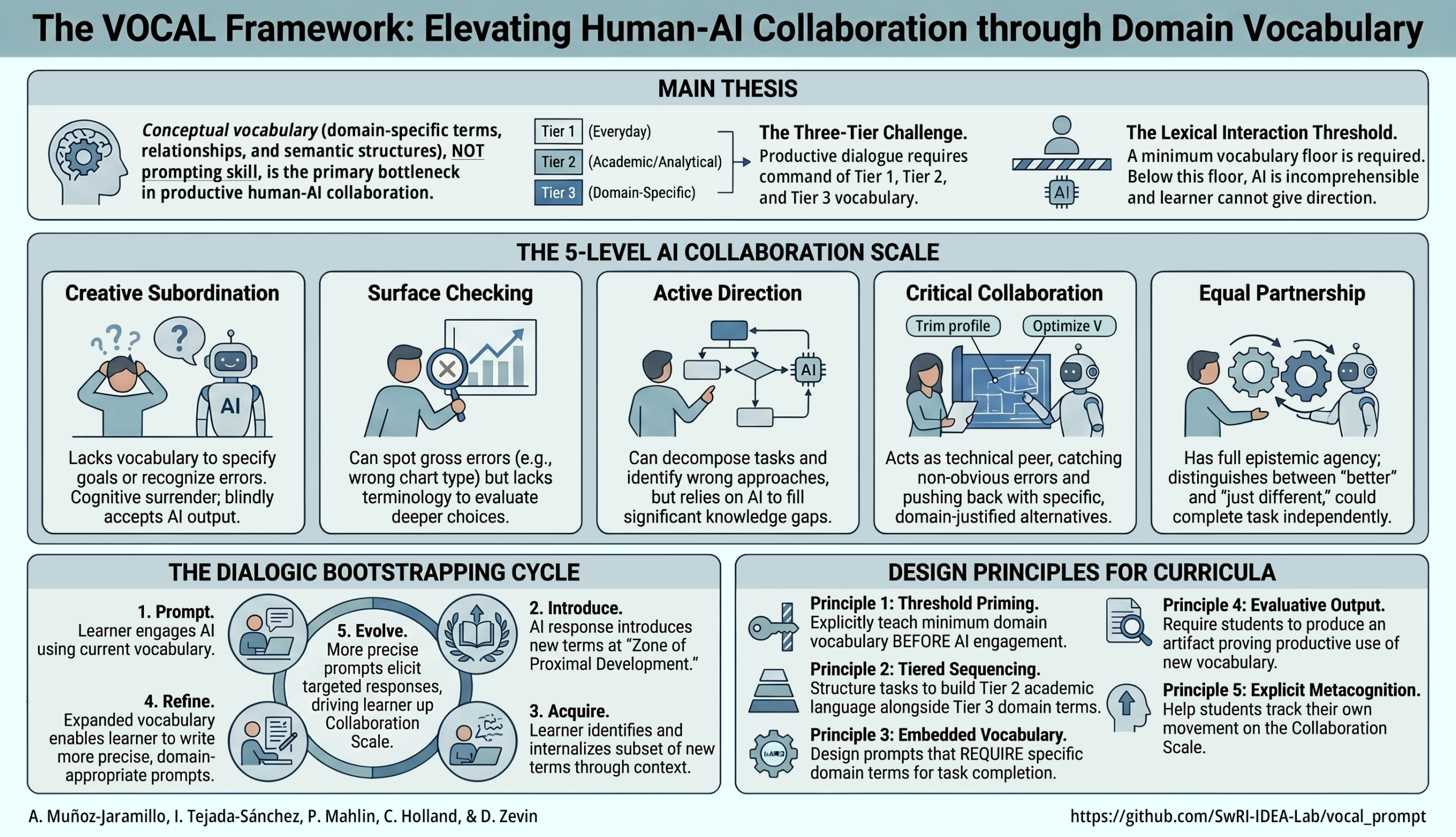
The dominant approach to improving human-AI collaboration treats effective use as a prompting skill problem. We argue this framing is incorrect. Domain-specific conceptual vocabulary (the terms, distinctions, and semantic structures a learner commands) is the primary bottleneck: no amount of prompting techniques will help a learner who cannot describe what they need.
We introduce VOCAL (Vocabulary-Oriented Collaboration with AI for Learning), a framework synthesizing evidence from prompt engineering research, vocabulary–concept co-evolution theory, and epistemic agency frameworks. We first describe the concept of lexical interaction threshold — the minimum domain vocabulary necessary for productive AI dialogue, below which AI responses are largely incomprehensible and queries too underspecified to elicit useful responses. Second, we propose a five-level AI Collaboration Scale mapping vocabulary mastery to epistemic agency quality: from Creative Subordination (no evaluative capacity) through Surface Checking, Active Direction, and Critical Collaboration to Equal Partnership (full technical direction with nuanced evaluation). Third, we formalize dialogic bootstrapping — a positive feedback loop in which iterative AI dialogue expands domain vocabulary, enabling progressively more precise prompting and more productive responses at each subsequent iteration.
We derive five design principles for curricula that deliberately cultivate this bootstrapping process and argue that improving domain knowledge is the most effective route to improving AI collaboration. The path to better prompting runs not through prompting guides, but through deeper disciplinary understanding.