

Authors: Enosh Herath Mudiyanselage (Georgia State University), Xiaochun He (Georgia State University), Viacheslav M Sadykov (Georgia State University), Chi-Kuang Yeh (Georgia State University), Tharindu G Hettiarachchi (Georgia State University)
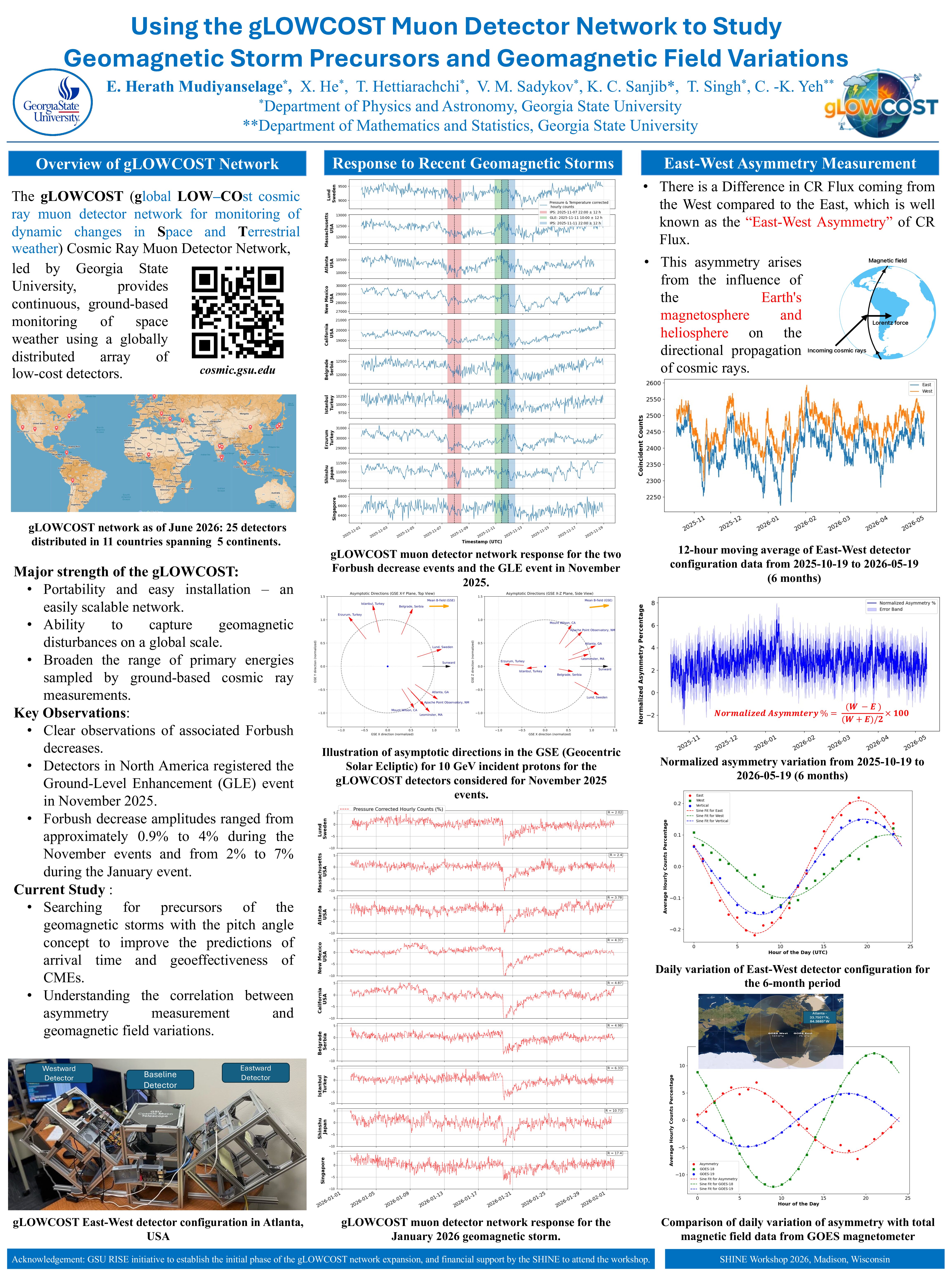
The gLOWCOST (global LOW–COst cosmic ray muon detector network for monitoring of dynamic changes in Space and Terrestrial weather) cosmic ray muon detector network—led by Georgia State University—provides continuous, ground‑based monitoring of space weather using a globally distributed array of low‑cost detectors. The network currently includes more than 25 detectors across 11 countries and 5 continents, with continued expansion underway. During the significant geomagnetic storms of November 2025 and January 2026, most stations operated stably and recorded clear Forbush decrease signatures. In addition, North American detectors observed the ground-level enhancement event associated with the November 2025 activity. The observed Forbush decrease amplitudes ranged from approximately 0.5% to 4.5% during the November events and from 2% to 7% during the January event.
A major strength of the gLOWCOST network is its ability to capture these disturbances on a global scale, enabling comparative analyses across sites with different latitudes, longitudes, altitudes, and geomagnetic cutoff rigidities. The current study focuses on quantifying potential precursors of geomagnetic storms using multi-site muon observations, with the goal of improving space weather prediction capabilities.
In addition, a unique East–West asymmetry detector configuration is being implemented, in which two detectors are oriented toward eastern and western directions to measure directional differences in the muon flux. This setup allows monitoring of east–west anisotropies in cosmic ray intensity, which may provide sensitivity to geomagnetic field variations. Future work will expand this configuration to multiple locations at different latitudes, enabling studies of the global behavior of geomagnetic field changes using directional cosmic ray muon observations.