

Authors: Rudra Kafle (Worcester Polytechnic Institute), Cutter Beck (Worcester Polytechnic Institute), Evan Smith (Worcester Polytechnic Institute), Jacob Whitehill (Worcester Polytechnic Institute), and Khagendra Katuwal (New Mexico State University)
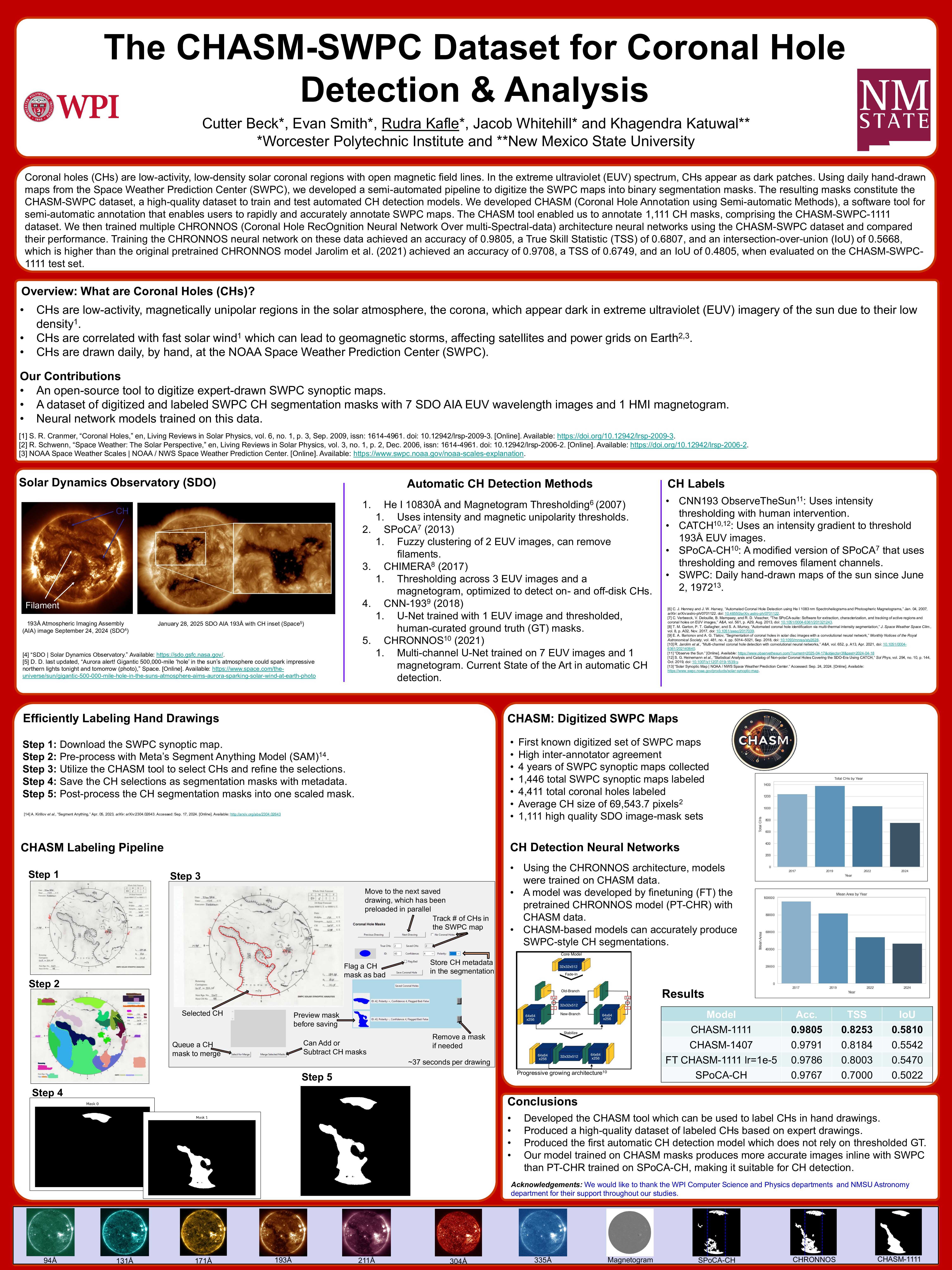
Coronal holes (CHs) are low-activity, low-density solar coronal regions with open magnetic field lines. In the extreme ultraviolet (EUV) spectrum, CHs appear as dark patches. Using daily hand-drawn maps from the Space Weather Prediction Center (SWPC), we developed a semi-automated pipeline to digitize the SWPC maps into binary segmentation masks. The resulting masks constitute the CHASM-SWPC dataset, a high-quality dataset to train and test automated CH detection models. We developed CHASM (Coronal Hole Annotation using Semi-automatic Methods), a software tool for semi-automatic annotation that enables users to rapidly and accurately annotate SWPC maps. The CHASM tool enabled us to annotate 1,111 CH masks, comprising the CHASM-SWPC-1111 dataset. We then trained multiple CHRONNOS (Coronal Hole RecOgnition Neural Network Over multi-Spectral-data) architecture neural networks using the CHASM-SWPC dataset and compared their performance. Training the CHRONNOS neural network on these data achieved an accuracy of 0.9805, a True Skill Statistic (TSS) of 0.6807, and an intersection-over-union (IoU) of 0.5668, which is higher than the original pretrained CHRONNOS model Jarolim et al. (2021) achieved an accuracy of 0.9708, a TSS of 0.6749, and an IoU of 0.4805, when evaluated on the CHASM-SWPC-1111 test set.