

Authors: X. Yu (UW-Madison), J. Egedal (UW-Madison), P. Gradney (UW-Madison), C. Kuchta (UW-Madison), J. Nordstrom (UW-Madison), J. Olson (UW-Madison), & C. Forest (UW-Madison)
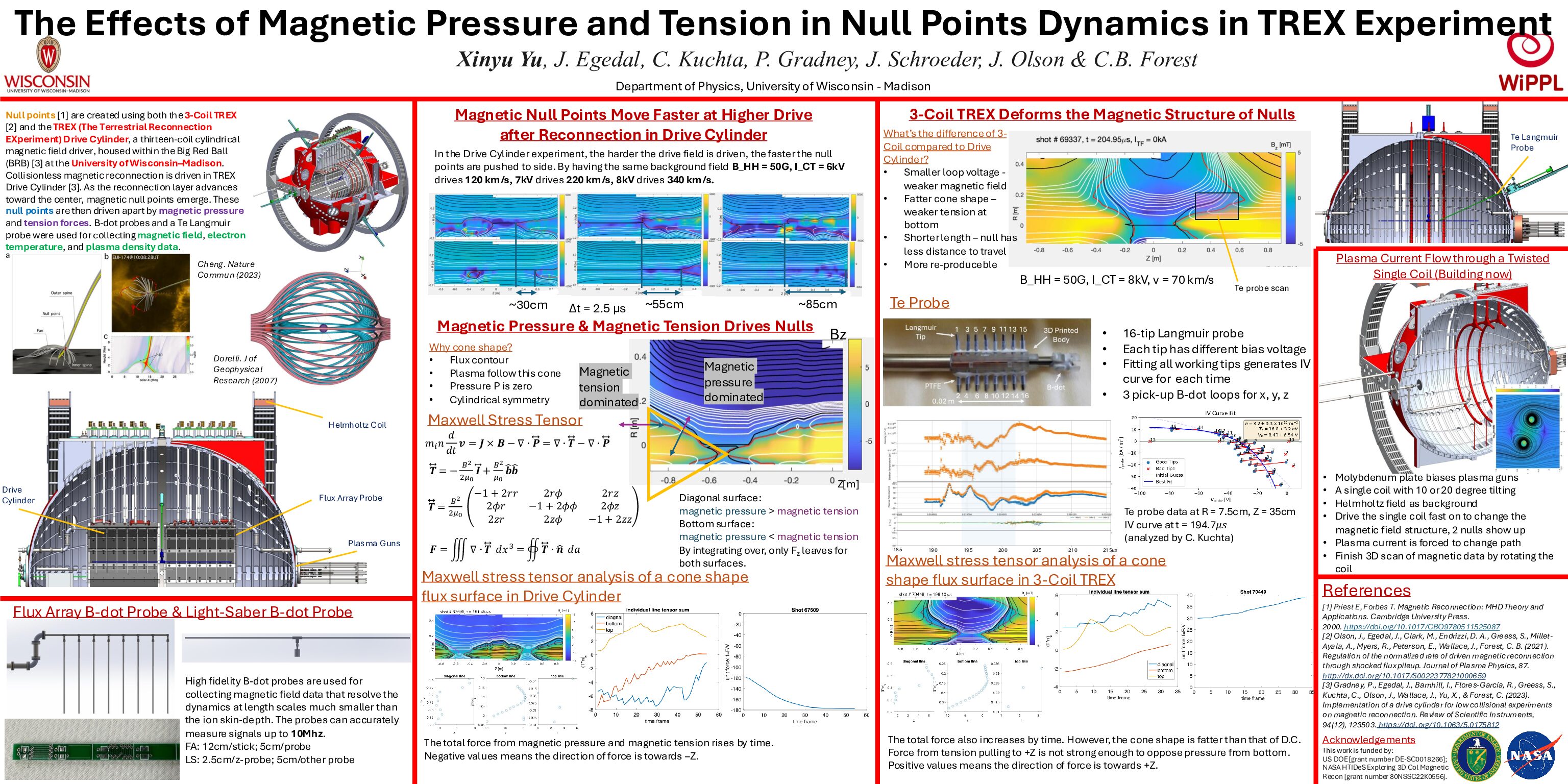
In configurations observed in natural systems, 3D magnetic null points often appear during magnetic reconnection. In the Terrestrial Reconnection Experiment (TREX) implemented at the Wisconsin Plasma Physics Laboratory (WiPPL), magnetic reconnection is studied under controlled conditions in the collisionless regime. The applied configuration includes a cylindrically symmetric reconnection layer imploding onto the central axis of the experiment. The reconnection process ends as the reconnection layer reaches the center axis characterized by the formation of a double null-point configuration. This poster will discuss how the two null points form, the rapid separation along the experimental z-axis, and the energy conversion due to field line shortening. A 16-tip Langmuir probe is used for collecting data of electron density, electron temperature, plasma potential, etc. High fidelity B-dot probes are used for collecting magnetic field data that resolve the dynamics at length scales much smaller than the ion skin-depth. The data has been processed to show the propagation of current layer of magnetic reconnection and magnetic nulls. The experiment reveals the importance of two-fluid Hall effects yielding both quadrupolar and octopolar structures in the out-of-plane magnetic field.