

Authors: Aidan Nakhleh (University of Michigan), Nicholeen Viall (NASA Goddard Space Flight Center), Sue Lepri (University of Michigan), Jim Raines (University of Michigan)
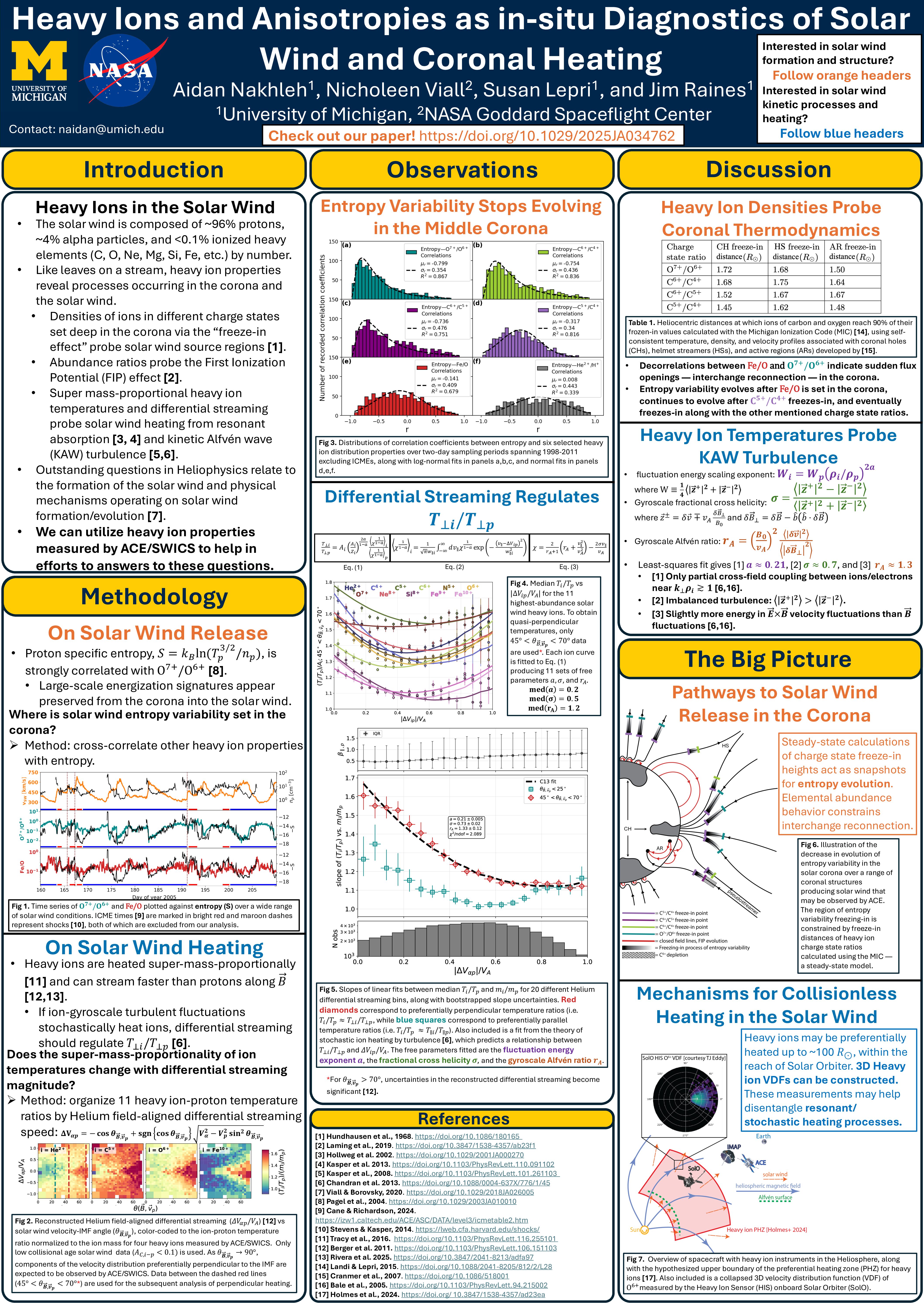
Density and abundance ratios of heavy ions in the solar wind can be used to probe the low solar corona through the freeze-in and First Ionization Potential (FIP) effects, while their thermal and bulk speeds can probe both collisionless and collisional processes in the solar wind. We present results demonstrating how heavy ion properties act as diagnostics for physical processes spanning different regimes within the heliosphere. Through a cross-correlation analysis between heavy ion density/abundance ratios and proton specific entropy measured by the Advanced Composition Explorer from 1998-2011, we find that the variability in solar wind fluid entropy freezes-in between approximately 1.4-1.8 solar radii in heliocentric distance, constraining time-dependent processes in solar wind formation. Additionally, it has been suggested that heavy ions are preferentially heated by the same mechanisms that energize the solar wind in the mid-to-high corona. We find that in the collisionless solar wind, heavy ion temperatures are regulated by ion differential streaming in a manner compatible with stochastic heating from ion-gyroscale turbulent fluctuations. These analyses, based on measurements of heavy ions at 1 AU, can be extended to data collected by the Solar Wind Analyzer suite onboard Solar Orbiter, further constraining how both mesoscale solar wind structures and kinetic properties evolve with heliocentric distance.