

Authors: Arman Manookian (New Jersey Institute of Technology), Alexander Kosovichev (New Jersey Institute of Technology), Samuel Granovsky (New Jersey Institute of Technology), Irina Kitiashvili (NASA Ames Research Center)
Magnetoacoustic waves in solar active regions are shaped by the local magnetic-
field topology, and their behavior near polarity inversion lines in δ-type regions
remains poorly characterized. In particular, it is unclear how the unique magnetic
field structure of the PILs in δ-type regions modify the spatial distribution of
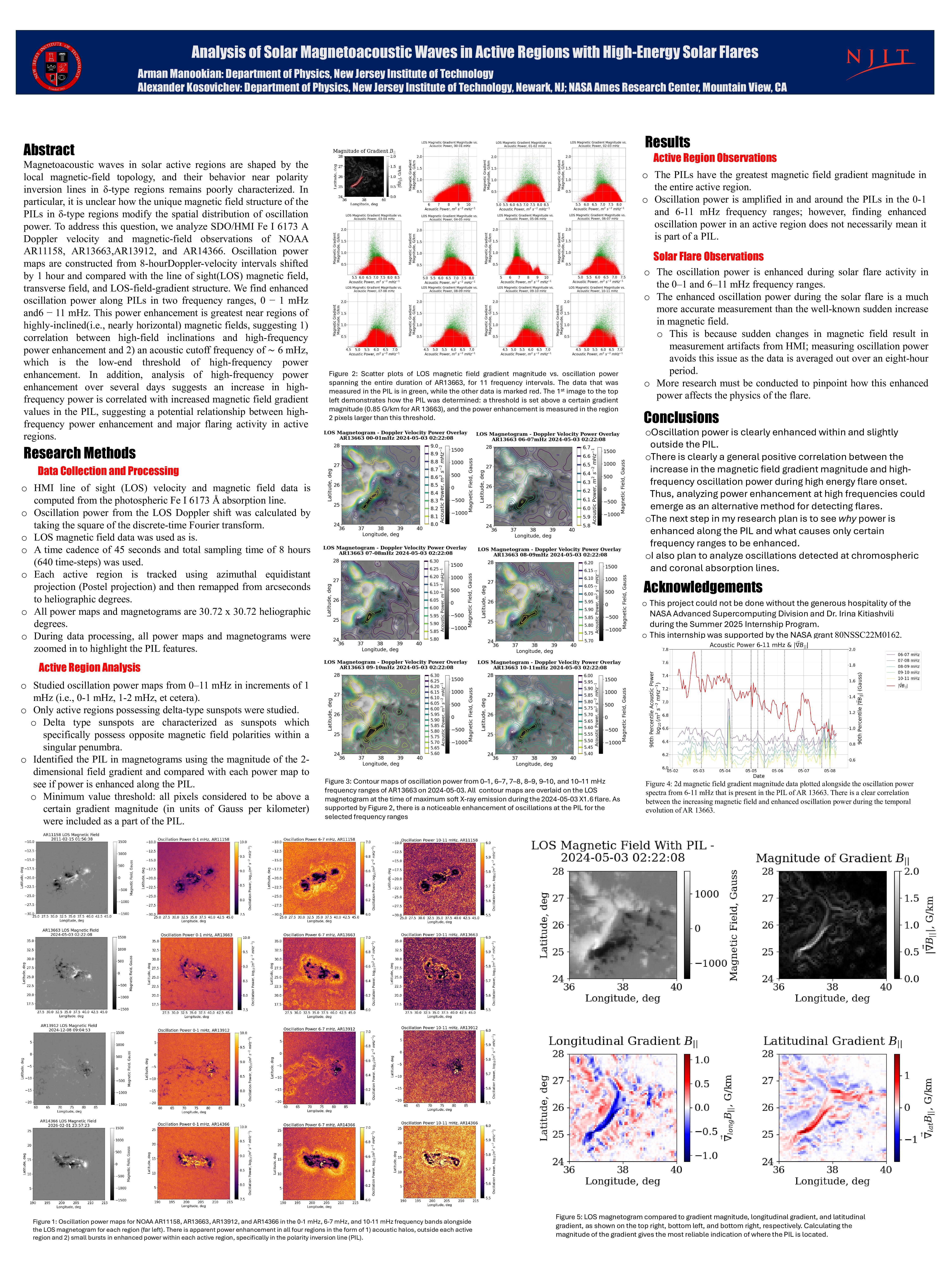
oscillation power. To address this question, we analyze SDO/HMI Fe I 6173 A
Doppler velocity and magnetic-field observations of NOAA AR11158, AR13663,
AR13912, and AR14366. Oscillation power maps are constructed from 8-hour
Doppler-velocity intervals shifted by 1 hour and compared with the line of sight
(LOS) magnetic field, transverse field, and LOS-field-gradient structure. We find
enhanced oscillation power along PILs in two frequency ranges, 0 − 1 mHz and
6 − 11 mHz. This power enhancement is greatest near regions of highly-inclined
(i.e., nearly horizontal) magnetic fields, suggesting 1) correlation between high-
field inclinations and high-frequency power enhancement and 2) an acoustic
cutoff frequency of ∼ 6 mHz, which is the low-end threshold of high-frequency
power enhancement. In addition, analysis of high-frequency power enhancement
over several days suggests an increase in high-frequency power is correlated with
increased magnetic field gradient values in the PIL, suggesting a potential rela-
tionship between high-frequency power enhancement and major flaring activity
in active regions.