

Authors: Matthias Rempel (HAO/NSF NCAR), Georgios Chintzoglou (LMSAL)
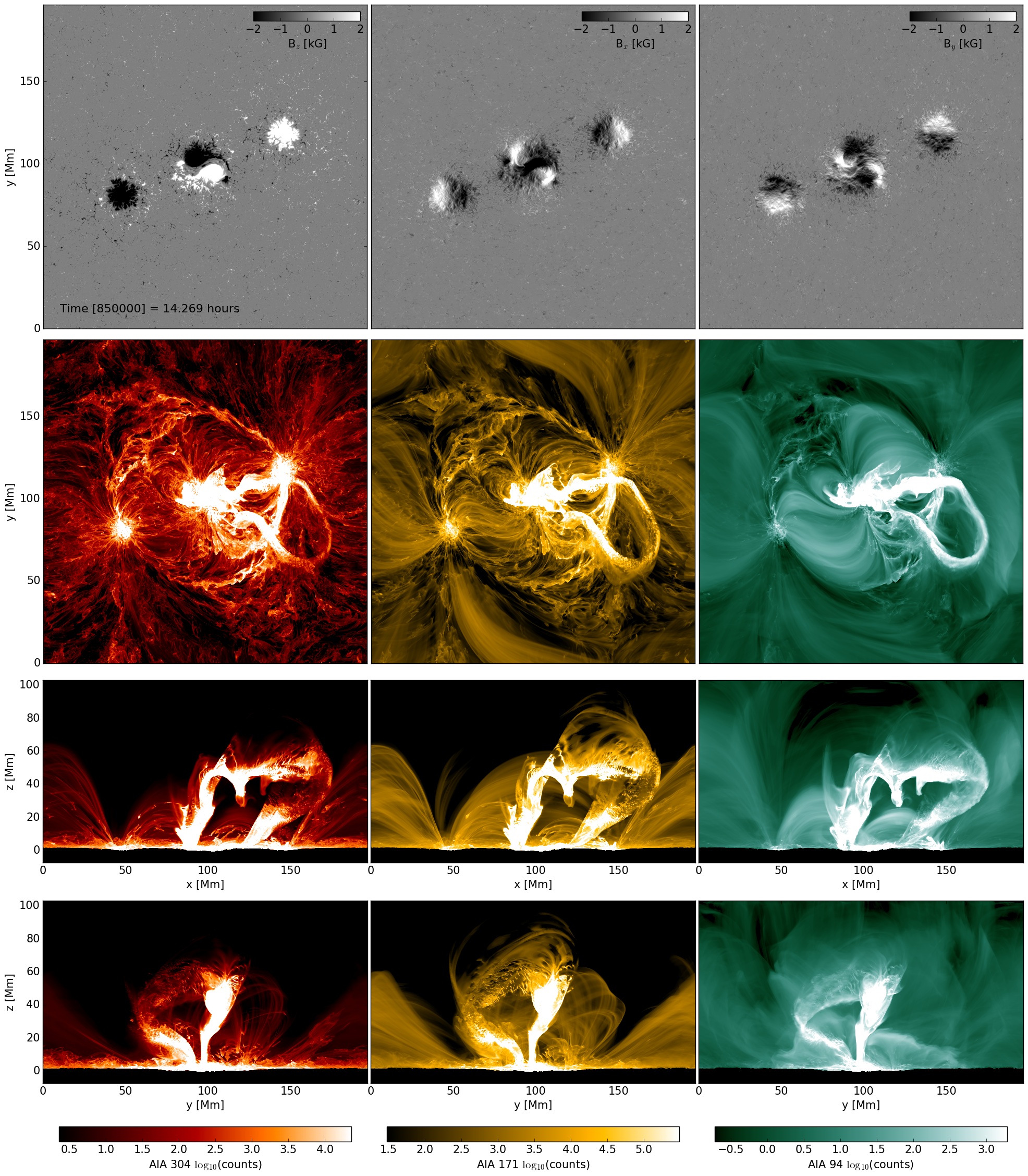
We present a data-inspired simulation of NOAA active region AR 11158. To this end we simulate the formation of a collisional polarity inversion line (cPIL) by moving sunspots in a quadrupolar configuration along the centroid positions extracted from AR 11158. This process builds up free energy in the corona exceeding 4*10^32 erg, out of which about 2*10^32 erg are released in a X-flare followed by series of smaller flares in the B to M range. The 4 strongest flares are associated with coronal mass ejections. About 1-2 hours prior to the X-flare, we see the formation of a magnetic flux rope (MFR) located above the cPIL. About 5 minutes before the flare, we see an upflow at chromospheric heights associated with a slow rise of the MFR. At the time when the first signatures of the starting eruption are visible in synthetic EUV emission, parts of the MFR enter regions with a decay index larger than 1.5, indicating that the flare initiation is consistent with the torus instability. Comparing the series of flares in this simulation to properties of observed flares, we find a comparable trend between flare energy and GOES X-ray flux, but flare duration falls into the short end of the observed solar distribution. As a consequence, energy fluxes into the flare ribbons can be substantial, reaching 10^13 erg/cm^2/s for the simulated X-flare. The X-flare causes step-function like changes of the horizontal magnetic field in the photosphere, a propagation of a momentum pulse into the convection zone and quasi-periodic pulsations in the volume of the corona with periods from sub seconds to multiple 10 seconds.