

Authors: Nariaki Nitta (Lockheed Martin Advanced Technology Center), Tamitha Skov (Millersville University), Meng Jin (Lockheed Martin Advanced Technology Center)
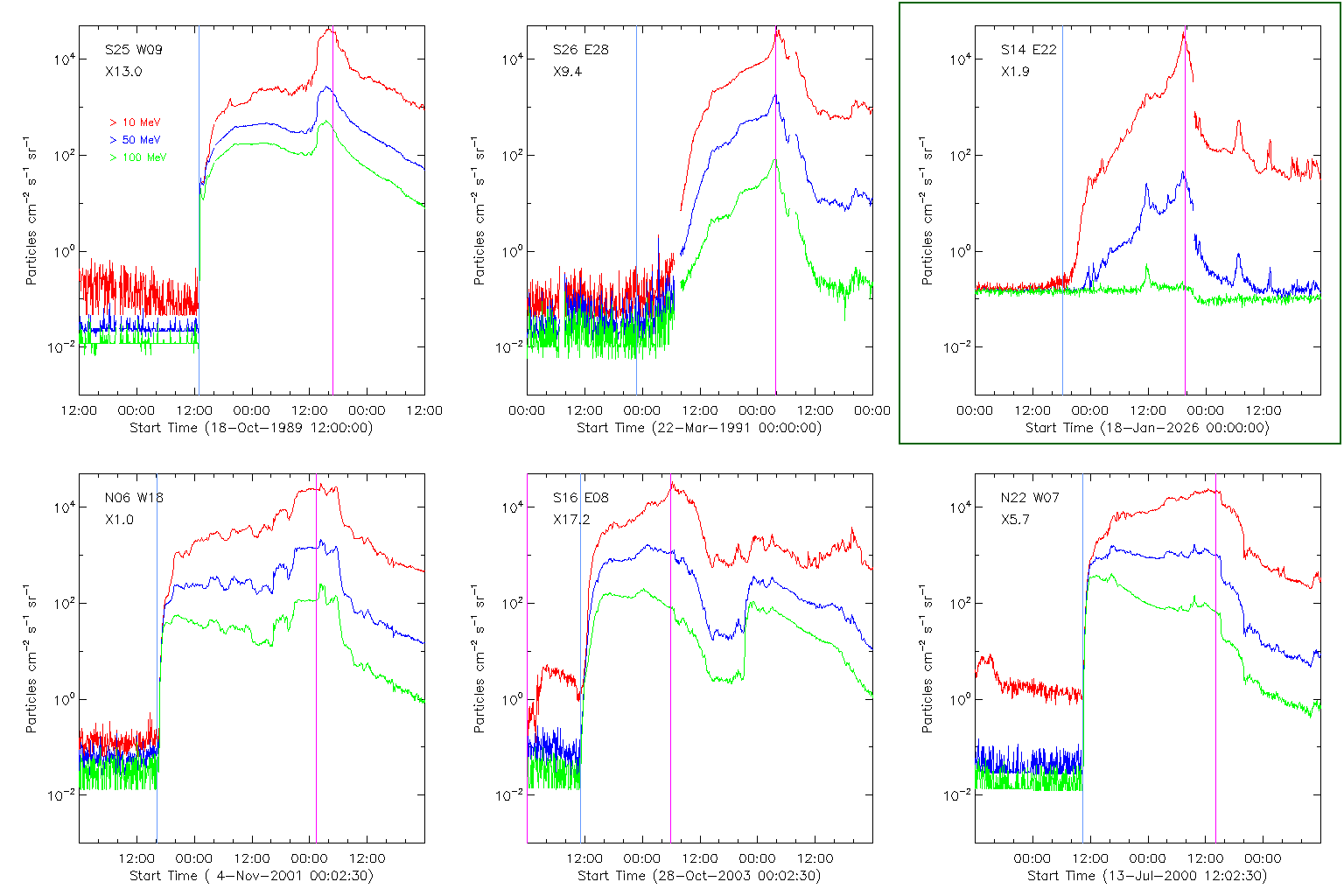
We discuss how the following two recent periods may qualify as quasi-extreme space weather. Strong interplanetary (IP) shocks appear to be the main ingredient. In November 2025, four fast CMEs occurred within five days, each associated with an X-class flare. Although the third event had the highest soft X-ray peak flux and CME speed, giving rise to a ground level enhancement (GLE) event, it was the shock wave from the second eruption that was more surprising. Catching up with the first CME, it arrived much earlier than expected, causing not only a G5 geomagnetic storm but also a very rare energetic storm particle (ESP) event extending beyond 100 MeV. In January 2026, an apparently isolated CME (also associated with an X1.9 flare) drove a shock wave that remained strong when it arrived at 1 AU. The resulting ESP event reached the >10 MeV flux levels not observed since 1991 March 22 but its spectrum was very soft, in sharp contrast to the November 2025 event. This shock was again responsible for a G5 (Kp=9-) geomagnetic storm. We try to evaluate the relative roles of intrinsic CME properties and interplanetary preconditioning for producing these quasi-extreme radiation storm conditions of different kinds. Other similar historical events are also examined to find what stood out in our recent events.