

Authors: C. Gilly (NWRA)
The PUNCH mission images the young solar wind across a field of view that spans several orders of magnitude in heliocentric distance, from the inner corona out into the heliosphere. Placing those data in context, however, requires stitching them together with imagers that see closer to the Sun; no single instrument covers the full range, and the familiar plane-of-sky frame grows increasingly awkward as one moves far off-limb. We explore how to build, and how best to display, a seamless composite that spans this range.
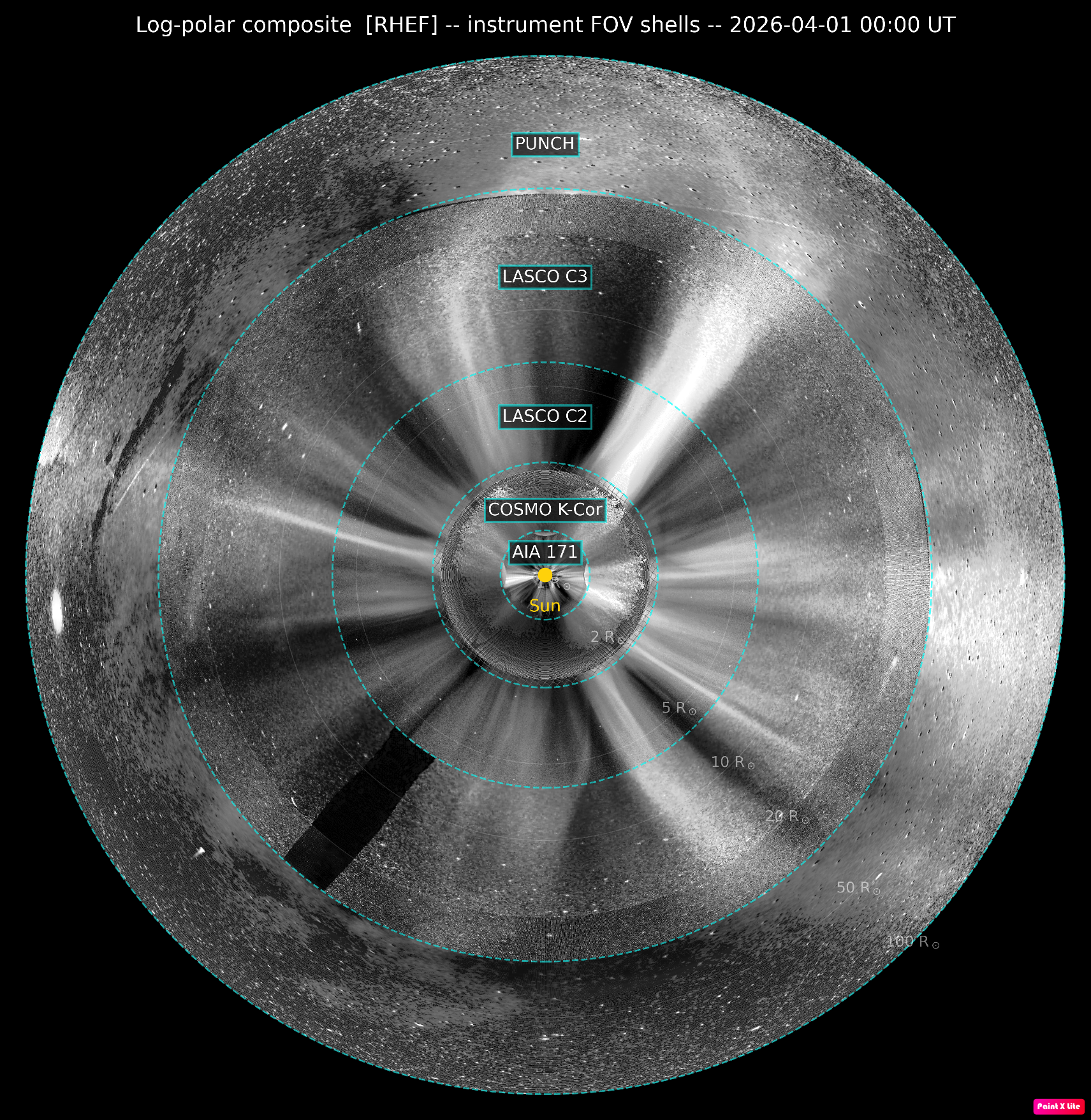
We assemble a chain of co-temporal images (GOES/SUVI, MLSO/COSMO K-Cor, SOHO/LASCO C2 and C3, and PUNCH) onto a common frame, illustrated here with a coronal mass ejection observed on 2026 April 2. We normalize each with the Radial Histogram Equalization Filter (RHEF) to tame the steep radial falloff so that structure flows continuously from the solar disk out to roughly 180 R☉. Where earlier work compared a handful of fixed projections, we now treat the radial mapping itself as a single continuous parameter, the Box-Cox exponent p, which contains the orthographic (p = 1), logarithmic (p = 0), and inverse (p = −1) views as special cases and every blend between them.
We cast this one mapping in two complementary forms: a Sun-centered disk, with the Sun at the center and radius re-stretched outward, and a rectilinear unwrap, with position angle along one axis and the stretched radius along the other. Notably, the logarithmic disk turns each instrument’s field of view into a concentric shell and brings the inner corona and the outer heliosphere onto a single footing; because the mapping is smooth in p, it is straightforward to tune the projection to the radial range a feature occupies. We developed these ideas in a bespoke proof-of-concept code, then implemented both projections, together with the RHEF, in JHelioviewer, where they are available now as a pre-release preview on a public fork while the contributions are merged upstream; a time-animated sweep of p is planned to follow. We discuss the composite’s use for following solar-wind and CME structures across the corona–heliosphere.