

Authors: Andrew M Leisner (George Mason University), Matt Dupertuis (George Mason University), Jie Zhang (George Mason University), Charles N. Arge (NASA/GSFC)
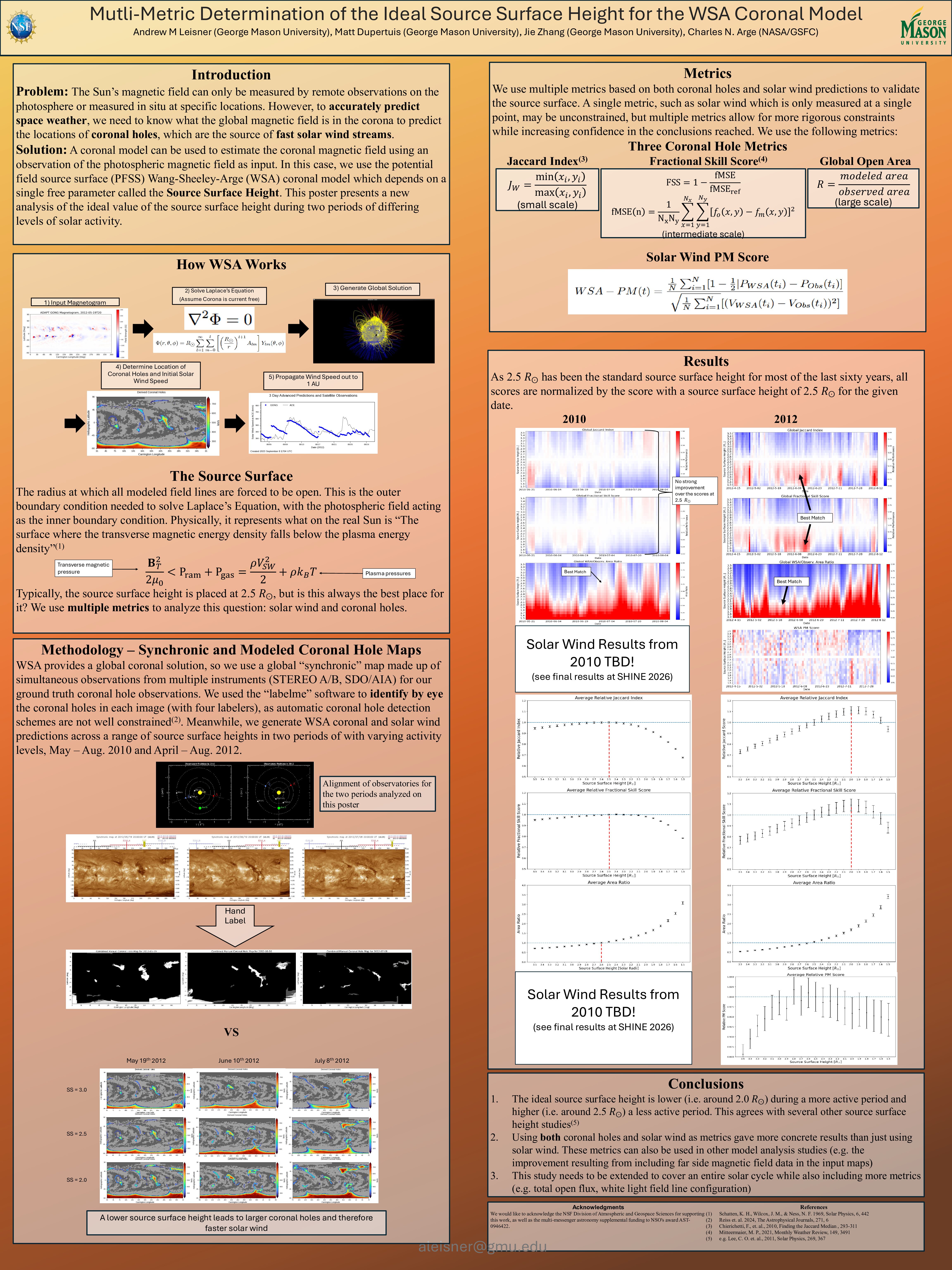
Potential Field Source Surface (PFSS) models of the Sun’s corona are an important tool in the prediction of space weather. One key free parameter is the location of the source surface height, which in the model represents the point at which all field lines are forced to be open. It has traditionally been set at 2.5 R⊙ for the majority of the last 60 years since the first PFSS models were developed. However, there is some evidence that this standard height may not be optimal for all periods, but existing studies investigating this further typically only use one metric for validation. In this study, we test a variety of source surface heights using a new methodology for validating the output of PFSS models through combining multiple metrics, including coronal hole predictions, the prediction of the solar wind speed at 1 AU, and the IMF polarity prediction at 1 AU. The calculations are based on the Wang-Sheeley-Arge (WSA) solar wind model. We find that, during a period of increased activity in 2012, the ideal source surface height is at 2.0 R⊙ instead of the standard 2.5 R⊙. Meanwhile, during a less active period in 2010, we find that the ideal source surface height is instead located closer to 3.0 R⊙. This shows that the maximum height of closed magnetic structures can vary throughout the solar cycle and that there is an anti-relation between solar activity and the source surface height. This relation is likely caused by the solar cycle variation of the strength of the transverse field component in closed loops versus the pressure of the plasma in the corona.