

Authors: Zeping Jin (UAH), Lingling Zhao (UAH), Xingyu Zhu (UAH)
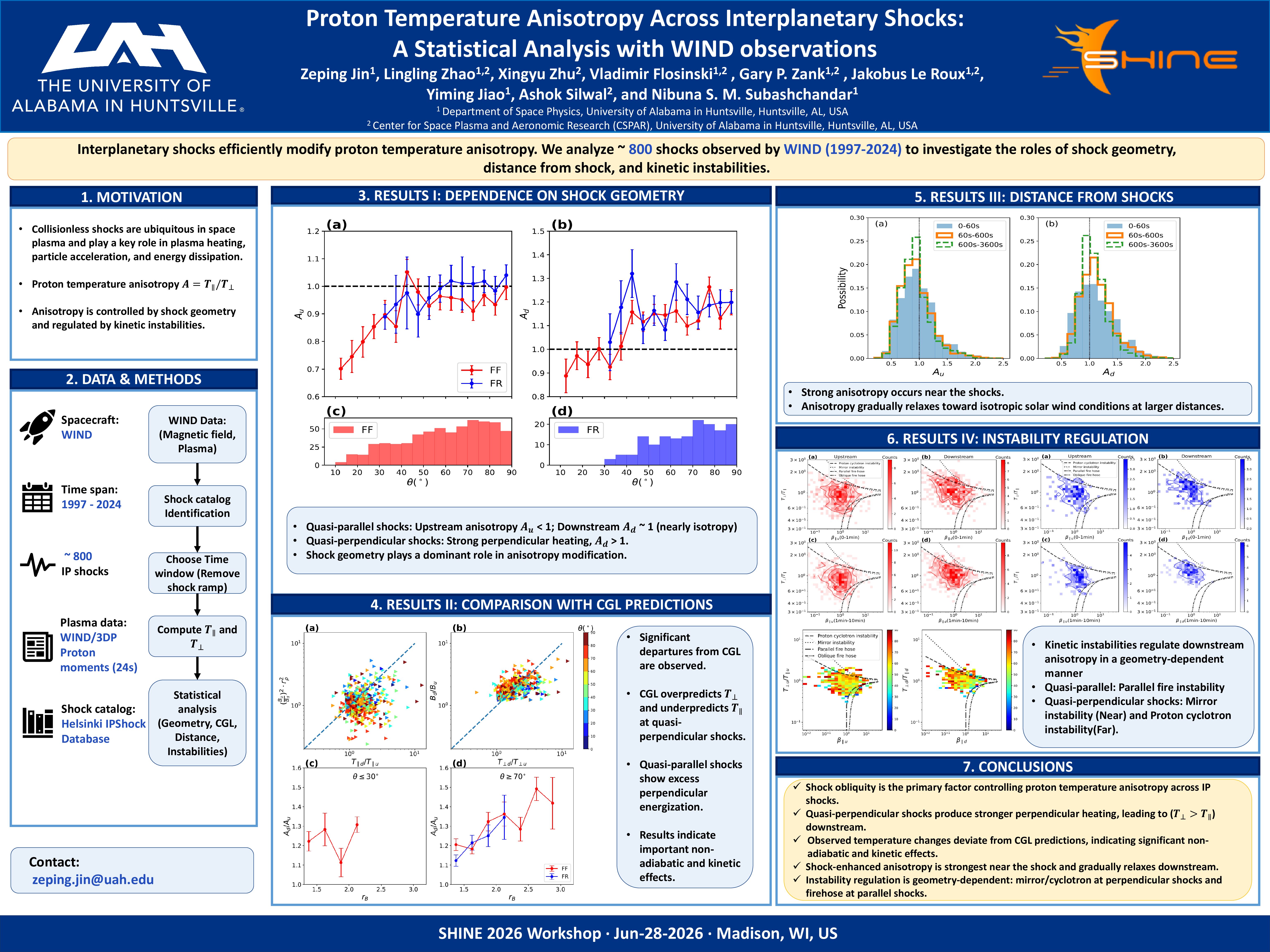
Interplanetary (IP) shocks efficiently modify the proton temperature anisotropy of the solar wind. Analyzing ∼800 IP shocks observed by the Wind spacecraft from 1997–2024, we present a statistical study of upstream and downstream proton temperature anisotropy and its dependence on shock geometry, compression, and distance from the shock. We find that (1) quasi-perpendicular shocks produce a pronounced enhancement of perpendicular temperature downstream, whereas parallel shocks remain near isotropic downstream due to typically stronger upstream parallel Temperature; (2) comparisons with the Chew–Goldberger–Low (CGL) double-adiabatic model reveal geometry-dependent deviations. CGL overestimates downstream perpendicular heating and underestimates parallel heating at quasi-perpendicular shocks, with the opposite trend at quasi-parallel shocks, highlighting the importance of non-adiabatic processes beyond simple compression; (3) Shock-driven anisotropy is strongly localized near the shock and gradually relaxes toward typical solar wind conditions farther downstream as the shock’s influence diminishes; and (4) downstream anisotropy is regulated by kinetic instabilities, with quasi-perpendicular shocks constrained by proton cyclotron and mirror instabilities and quasi-parallel shocks limited by the parallel firehose instability. Together, these results show that the evolution of temperature anisotropy at interplanetary shocks is controlled by shock geometry, localized processes, and instability-driven regulation.