

Authors: Evangelos Paouris (JHUAPL), Samantha Wallace (Department of Physical Sciences, Embry-Riddle Aeronautical University), Angelos Vourlidas (JHUAPL), Charles Nick Arge (GSFC, NASA)
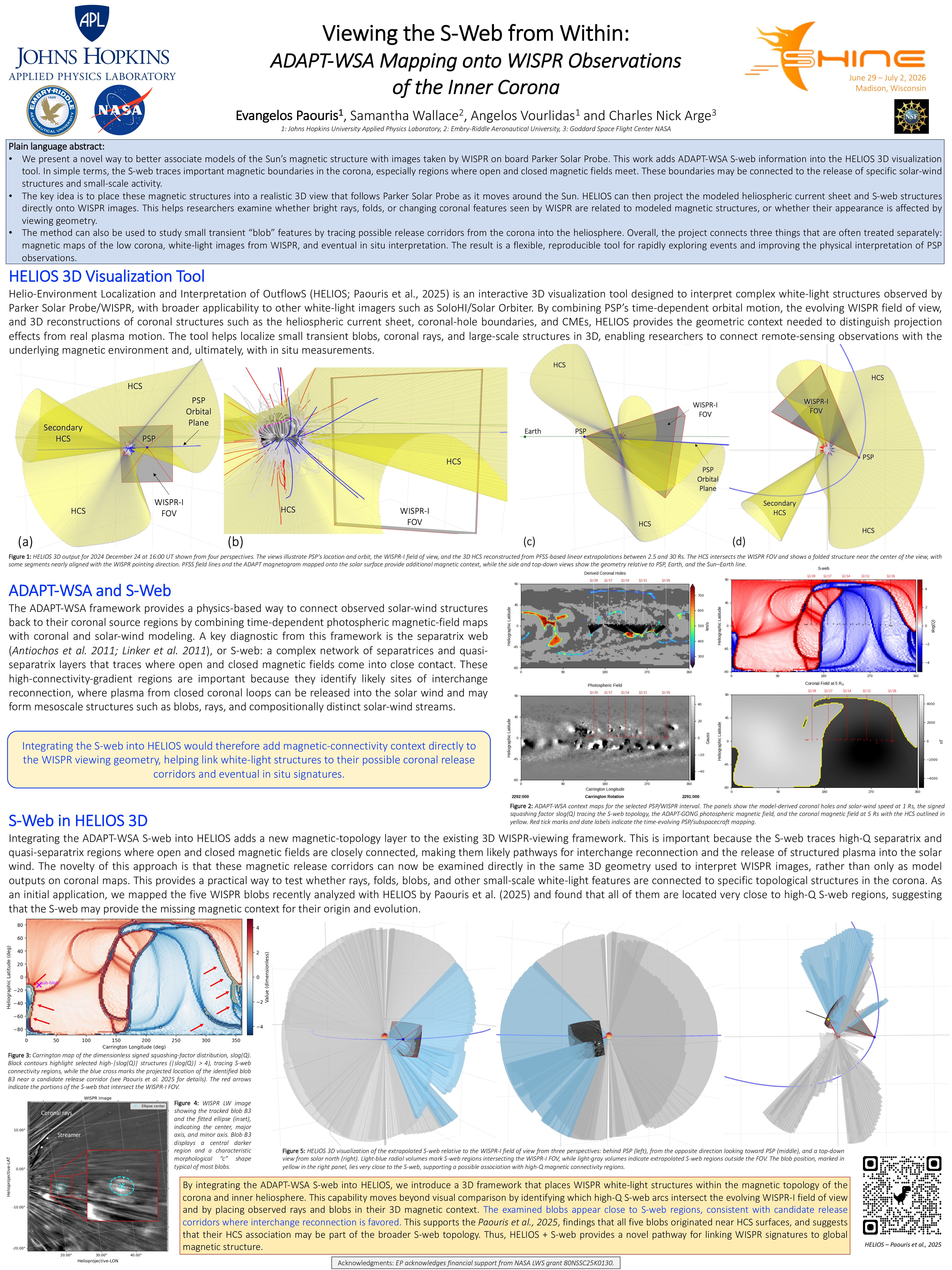
We present a 3D implementation of the ADAPT-WSA separatrix web (S-web) model within the HELIOS interactive visualization environment. The goal is to connect the magnetic topology of the corona with white-light structures observed by Parker Solar Probe/WISPR in a way that properly accounts for the observing geometry. In ADAPT-WSA, the S-web is described using the squashing factor Q. Thin, high-Q arcs trace the open–closed magnetic-field boundary as it extends into the corona and heliosphere, for example, at 5 Rsun, and highlight regions where interchange reconnection is expected to be more likely. HELIOS uses these S-web products together with ADAPT-based magnetic maps and PFSS/WSA context to build a 3D representation of the heliospheric current sheet (HCS), which can be explored interactively from the PFSS source surface at 2.5 Rsun outward using a linear extrapolation.
The main addition in this work is the inclusion of the S-web in the HELIOS 3D framework and its connection to the PSP/WISPR viewing geometry. HELIOS follows the time-dependent position of Parker Solar Probe and the changing WISPR field of view, allowing both the reconstructed HCS and the S-web to be projected directly onto the WISPR image plane. This makes it possible to use magnetic topology not only as model output, but also as a practical guide for interpreting WISPR observations. In particular, high-Q S-web arcs and their relation to folded or structured HCS segments can help explain the appearance of coronal rays and why their morphology changes with viewing geometry. The same framework can also be used to examine small transient “blob” structures by mapping possible S-web release corridors into the heliosphere and onto the WISPR images, providing a way to relate these features to regions where interchange reconnection is favored.
By bringing together coronal connectivity, open–closed boundary mapping, and the WISPR viewpoint in one 3D environment, the ADAPT-WSA/HELIOS pipeline provides a practical link between magnetic structure in the low corona, heliospheric imaging, and eventual in situ interpretation. The approach is designed to be reproducible and flexible, while remaining lightweight enough for rapid event studies and interactive exploration.