
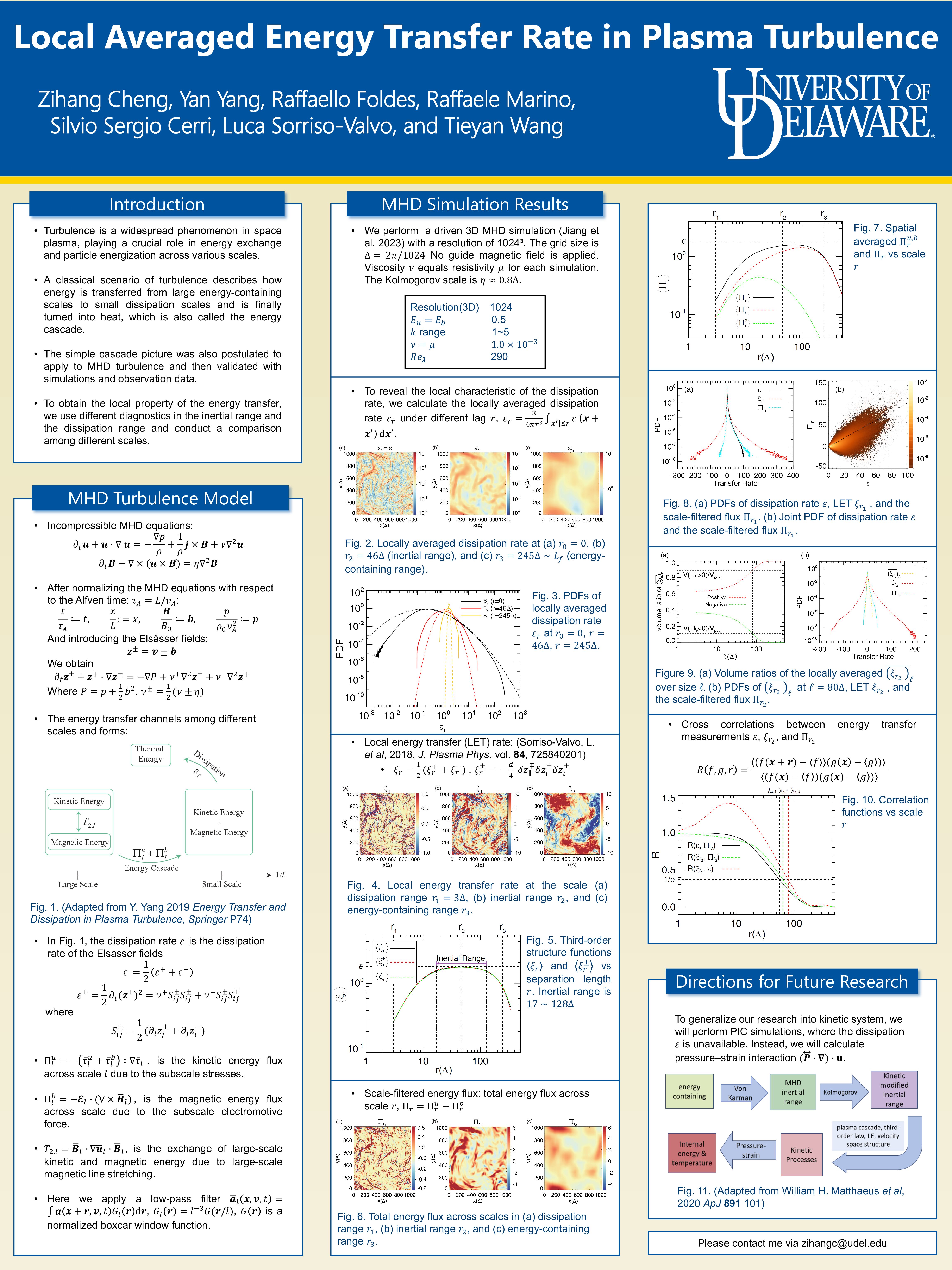


Authors: Zihang Cheng (Department of Physics and Astronomy, University of Delaware), Yan Yang (Department of Physics and Astronomy, University of Delaware), Raffaello Foldes (CNRS, École Centrale de Lyon, INSA Lyon, Université Claude Bernard Lyon 1, Laboratoire de Mécanique des Fluides et d’Acoustique), Raffaele Marino (CNRS, École Centrale de Lyon, INSA Lyon, Université Claude Bernard Lyon 1, Laboratoire de Mécanique des Fluides et d’Acoustique), Silvio Sergio Cerri (Université Côte d’Azur, Observatoire de la Côte d’Azur, CNRS, Laboratoire Lagrange, Bd de l’Observatoire), Luca Sorriso-Valvo (CNR, Institute for Plasma Science and Technology (ISTP); Department of Electromagnetics and Plasma Physics, School of Electrical Engineering and Computer Science, Royal Institute of Technology KTH), and Tieyan Wang (School of Earth Sciences, Yunnan University)
Energy transfer across scales is essential for understanding the dissipation and heating
of plasma turbulence. In the energy cascade scenario, the energy transfer rate can be
assessed through the third-order law in the inertial range, and it is directly related to
the rate of dissipation occurring at the small scale. To investigate the local properties of
the energy transfer process, here we employ three main diagnostics: the locally averaged
dissipation rate εᵣ at different scales r, the local energy transfer (LET) rate, and the
scale-filtered energy flux. The analyses are performed on direct numerical simulations
of three-dimensional (3D) incompressible magnetohydrodynamic (MHD) turbulence to
evaluate these diagnostics. The outcomes of our study include: (i) an assessment of the
spatial distribution of energy transfer rates across scales, to determine which diagnostic
best captures the features of energy transfer in different ranges; and (ii) a comparison
of the outputs of the different diagnostics at significant scales, including a quantitative
evaluation of their correlation using appropriate correlation coefficients. The latter shows
that the energy dissipation rate, the LET, and the scale-filtered energy flux have regional
correlation, that is, although not exactly co-located, the intense regions of these three
diagnostics occur in spatial proximity. Our results provide insights into understanding
the energy transfer process in MHD and plasma turbulence, which shall be extended to
more realistic systems.
