Meeting Lists
https://swe.ssa.esa.int/upcoming-events https://soho.nascom.nasa.gov/community https://spd.aas.org/meetings https://www.uksolphys.org/news/conferences

https://swe.ssa.esa.int/upcoming-events https://soho.nascom.nasa.gov/community https://spd.aas.org/meetings https://www.uksolphys.org/news/conferences
NASA’s Neil Gehrels Swift Observatory was launched in 2004 to detect and monitor gamma-ray bursts. After 21 years of science operations, Swift’s low Earth orbitView More
NASA Heliophysics is sponsoring a challenge for low-cost methods of measuring thermospheric density, pressure, or drag in low Earth orbit. The challenge will unfold across three phases, advancing upView More
The Habitable Worlds Observatory (HWO) is a large-aperture ultraviolet/visible/near-infrared observatory concept recommended by the National Academies of Science, Engineering, and Medicine decadal survey, “Pathways toView More
Click here to register The goal of this symposium is to catalyze the technology advancements needed to explore the Sun-Earth-Moon system, Mars, and beyond byView More
On July 23, NOAA Space Weather Prediction Center (SWPC) started releasing real-time operational images from the Compact Coronagraph 2 (CCOR-2) onboard the Space Weather ObservationsView More
Dear Colleagues,We are pleased to announce that nominations are now open for the 2026 International Space Weather and Space Climate Medals. The three medals recognizeView More
The T-2 group (Nuclear and Particle Physics, Astrophysics and Cosmology) in the Theoretical Division at Los Alamos National Laboratory (LANL) invites applications for two-year postdoctoralView More
Dear Solar Physics and Space Weather Colleagues, I’m pleased to invite you to the 24th Conference on Space Weather, part of the 107th American Meteorological SocietyView More
REGISTER NOW for NASA’s 2026 Joint HELIOTECH and Orbital Flight Symposium. Participation options include hybrid, onsite, and virtual attendance. Registration closes on August 14 for non-U.S. citizen participants andView More
Early registration is now open for the upcoming UK Space Weather & Space Environment Meeting IV: Space as a Global Endeavour meeting, 14-17 September 2026 at Northumbria UniversityView More
A postdoc position is available in Dr Christopher Chen’s research team at Queen Mary University of London to work on a new project supported byView More
Dear Colleagues, We’re pleased to invite abstract submissions to our AGU26 session: SM008 – From Solar Wind Forcing to Satellite Drag: Bridging Space Weather AcrossView More
Early registration is now open for the upcoming UK Space Weather & Space Environment Meeting IV: Space as a Global Endeavour meeting, 14-17 September 2026 atView More
We are pleased to announce the SABID 2026 workshop, co-located with the International Conference on Big Data 2026, Dec 14-17, 2026, at Sheraton Phoenix DowntownView More
The University of Helsinki invites applications for a full-time PhD researcher position in space plasma physics. The position is funded for approximately four years andView More
Authors: Marcel Corchado Albelo (University of Colorado, Boulder) In this talk we review recent observations that challenge the applicability of the CSHKP 2D standard flareView More
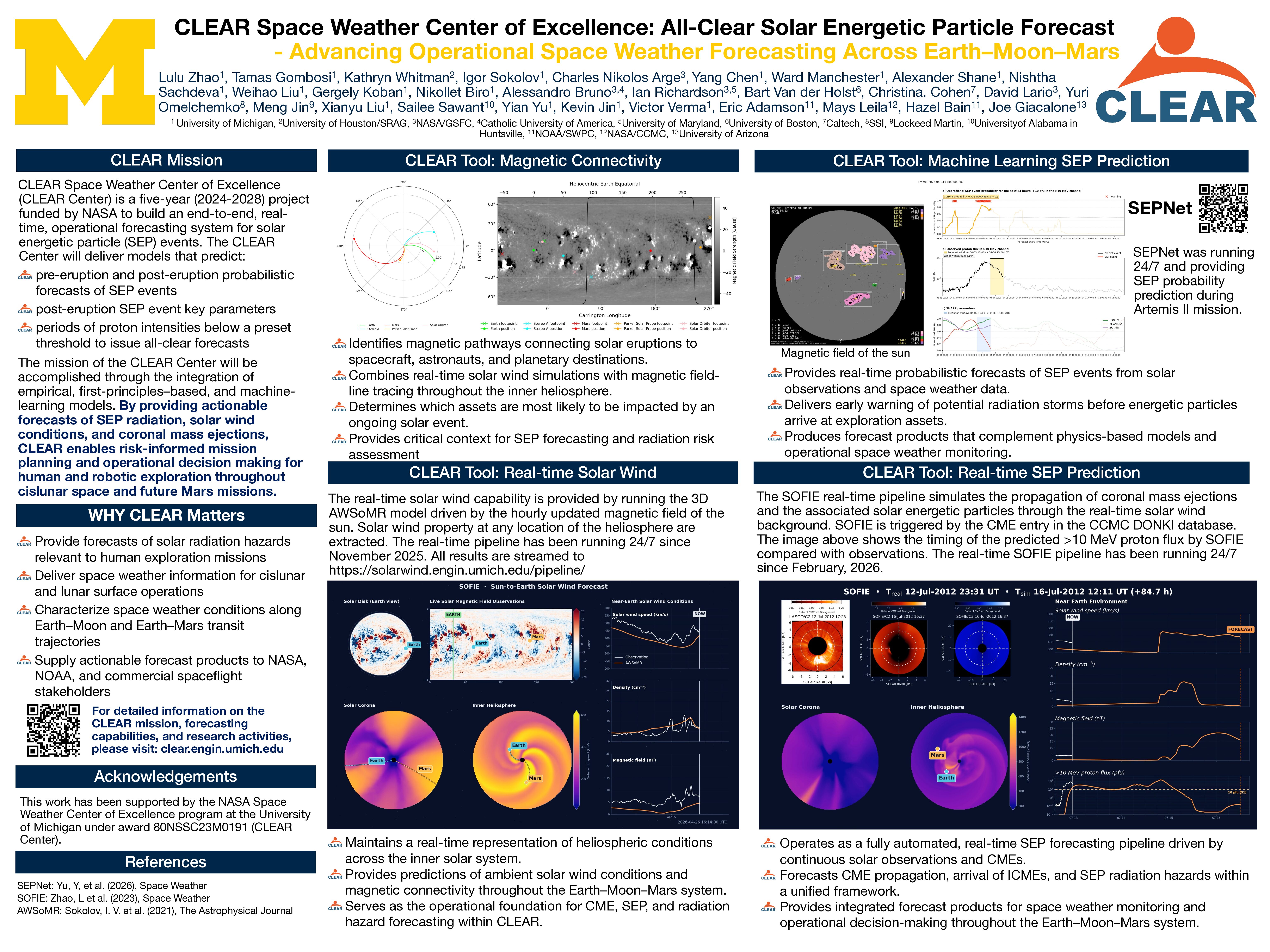
Authors: Lulu Zhao (University of Michigan), Tamas Gombosi (University of Michigan), and the CLEAR Team The Space Weather Center of Excellence CLEAR: All-CLEAR Solar EnergeticView More
Authors: Alessandro Bruno (NASA/GSFC & CUA) The solar eruptions of 11 November 2025 and 18 January 2026 produced two of the most remarkable space weatherView More
NOAA has started releasing real-time SupraThermal Ion Sensor (STIS) and Solar Wind Plasma Sensor (SWiPS) measurements from its Space Weather Observations at L1 to AdvanceView More
Authors: L. A. Fisk Observations and analysis of the behavior of the open magnetic field of the Sun, the component of the solar magnetic fieldView More
Authors: Jack M. Schroeder (University of Wisconsin-Madison), Jan Egedal (University of Wisconsin-Madison) Observations show particles are efficiently heated at astrophysical shocks. However, the relative contributionView More
Authors: Nada Al-Haddad (UNH), Noe Lugaz (SSC, EOS, UNH), Bin Zhuang (SSC, EOS, UNH), Sahanaj Banu (SSC, EOS, UNH), Charlie Farrugia (SSC, EOS, UNH) CoronalView More
Authors: Lidiya Ahmed; Michael Stevens; Samuel Badman; Aileen Niesta Most solar-wind prediction methods rely on boundary conditions specified at a fixed inner radius, typically derivedView More
Authors: Anthony Atkinson (Rice University), David Alexander (Rice University) Observations of magnetic fields in extrasolar environments are critical to the current theories of planetary formation,View More
Authors: William Taranto (University of Delaware), Riddhi Bandyopadhyay (University of Delaware) We analyze nearly three solar cycles of magnetic field observations from the Wind spacecraftView More
Authors: Katelyn Youngjohn, Ivan Vasko, Xi Lu, Vadim Roytershteyn We present a statistical analysis of 287 electrostatic solitary waves observed by the Magnetospheric Multiscale SpacecraftView More
Authors: Xiaohan Ma (BU), Lingling Zhao (UAH), Merav Opher(BU) The shape and structure of the heliosphere remain subjects of ongoing debate, particularly regarding the extentView More
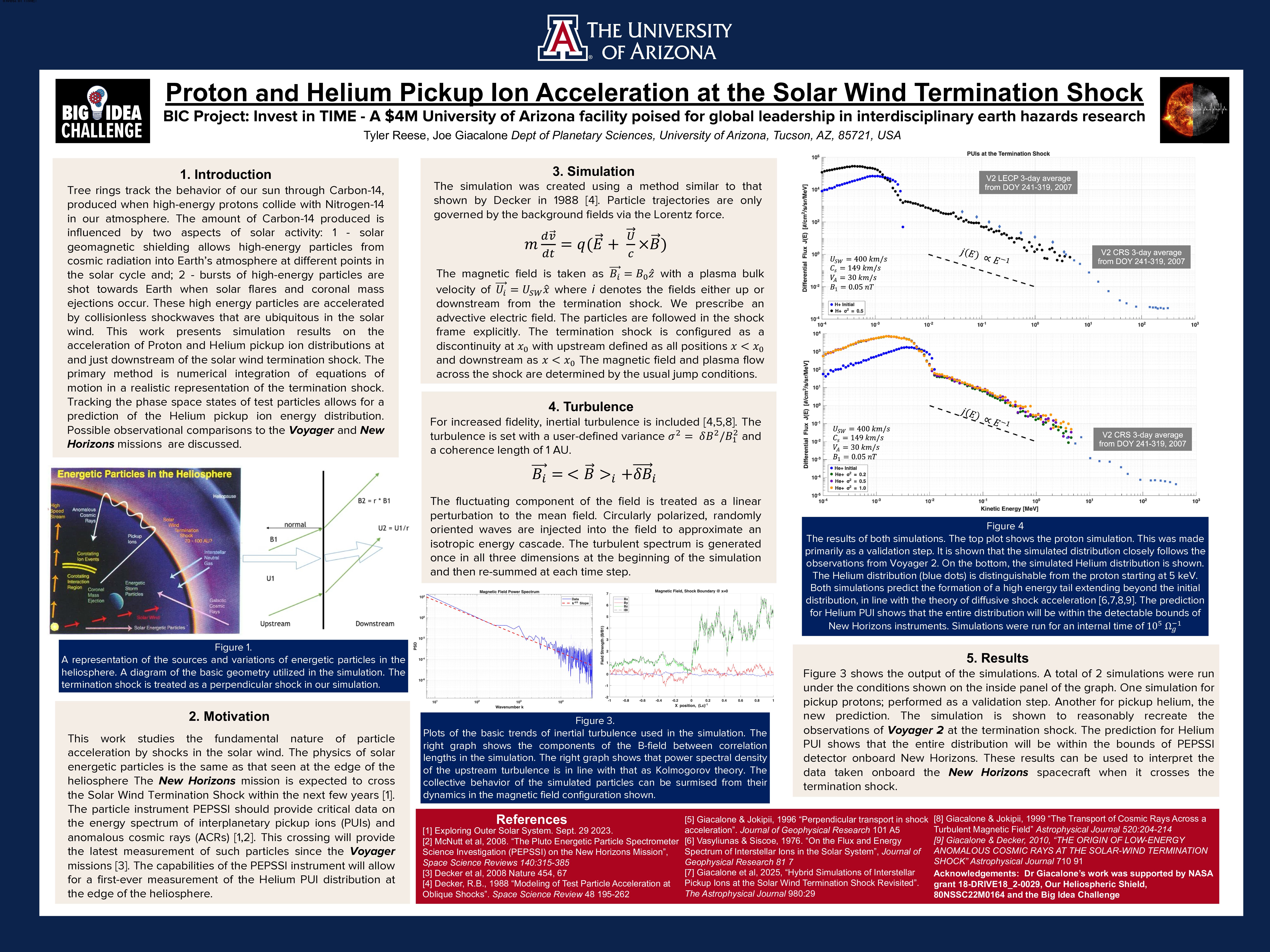
Authors: Tyler Reese (University of Arizona) Joe Giacalone (University of Arizona) The New Horizons mission is expected to cross the Solar Wind Termination Shock withinView More
Authors: David Galarza (University of Florida), Alicia Petersen (University of Florida) Pitch angle distributions (PADs) of suprathermal electrons serve as vital topological tracers of theView More
The NASA Space Weather Program would like to invite the community to participate in the “Mars L1 Workshop – Exploring a Red Planet Space WeatherView More
Authors: Chip Manchester (University of Michigan), Igor Sokolov (University of Michigan), Gergely Koban (University of Michigan), Nishtha Sachdeva (University of Michigan), Lulu Zhao (University ofView More
Authors: M. B. Khan (University of Delaware), M. A. Shay (University of Delaware) Magnetic reconnection plays an important role in the turbulent relaxation of space andView More
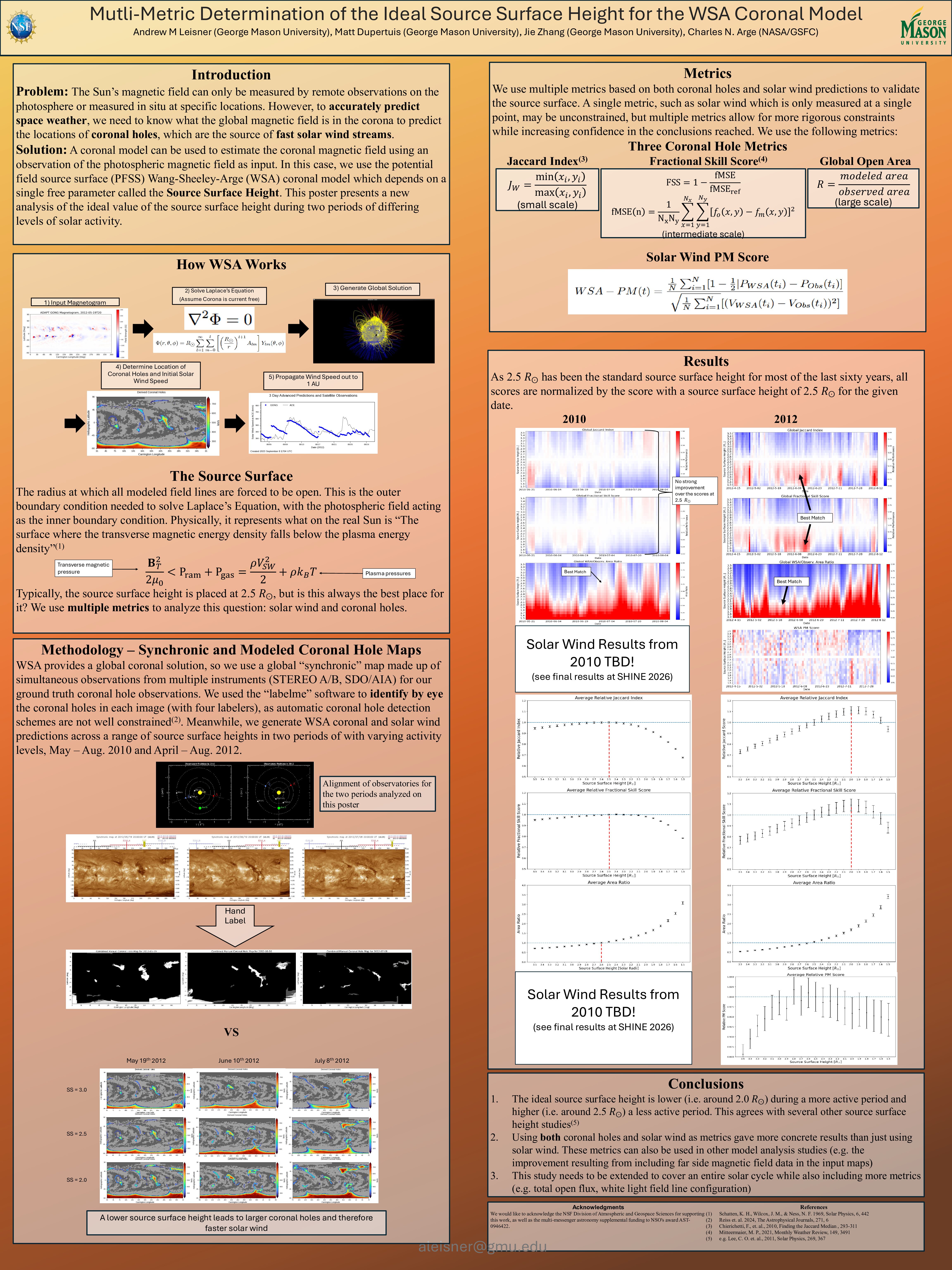
Authors: Andrew M Leisner (George Mason University), Matt Dupertuis (George Mason University), Jie Zhang (George Mason University), Charles N. Arge (NASA/GSFC) Potential Field Source SurfaceView More
Authors: Anna Fitzmaurice (UMCP), James Drake (UMCP), Marc Swisdak (UMCP) Extreme enhancements of 3He are commonly observed during impulsive SEP events, suggesting the presence ofView More
Authors: Samuel Fordin (NASA GSFC, Greenbelt, MD), Jaye Verniero (NASA GSFC, Greenbelt, MD), Adam Szabo (NASA GSFC, Greenbelt, MD), Yeimy Rivera (Harvard-Smithsonian Center for Astrophysics,View More
Authors: Dinesha V. Hegde (Center for Space Plasma and Aeronomic Research (CSPAR), the University of Alabama in Huntsville (UAH)), Sujit Roy (Earth System Science CenterView More
Authors: Arpita Roddanavar (NJIT), Satoshi Inoue (NJIT), Keitarou Matsumoto (NJIT, Nagoya University), Haimin Wang (NJIT) Magnetic flux ropes (MFRs) are widely regarded as fundamental structuresView More
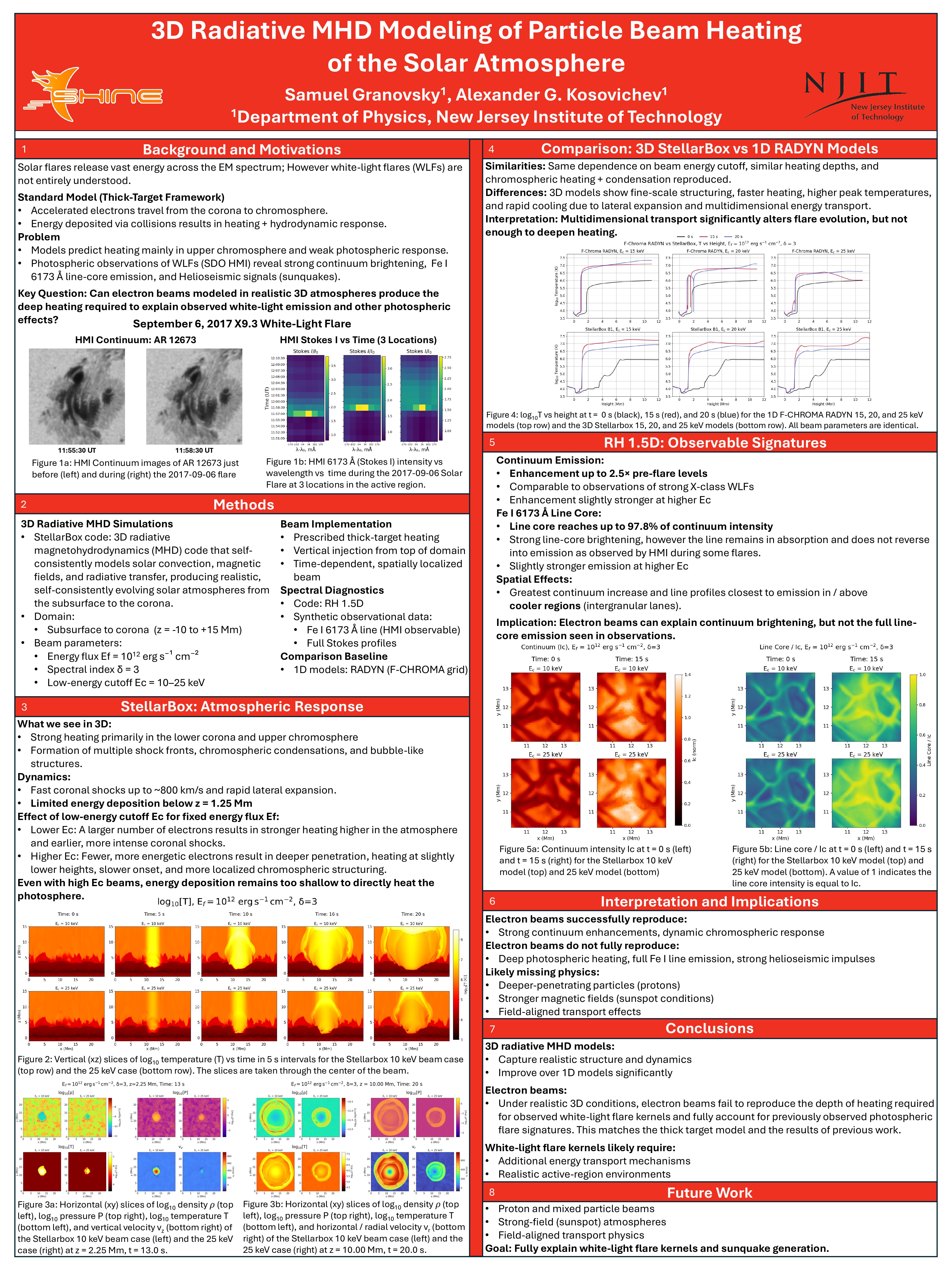
Authors: Samuel Granovsky (Department of Physics, New Jersey Institute of Technology, Newark, NJ 07102, USA), Alexander G. Kosovichev (Department of Physics, New Jersey Institute ofView More
Authors: Joel Dahlin (University of Maryland, College Park) A major unsolved problem in solar physics is understanding what determines whether a solar flare remains confinedView More